
|
| Xinjiang Today |
| Connectivity across the continent | |
|
|
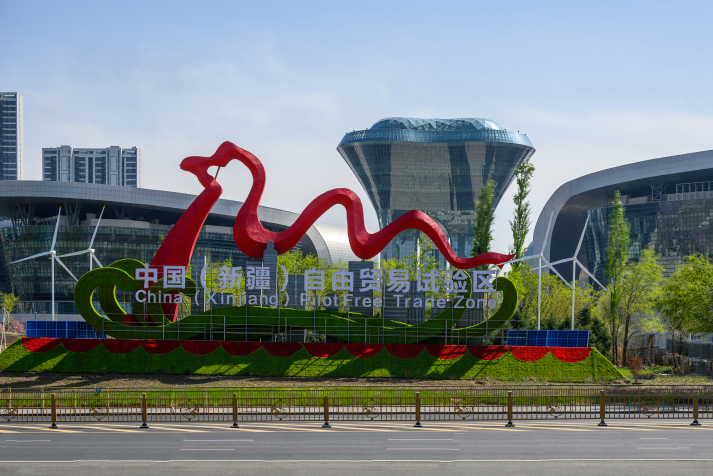 The Urumqi area of the China (Xinjiang) Pilot Free Trade Zone on April 19 (VCG)
For centuries, Urumqi has served as a gateway between China and Central Asia, with goods moved through the city along routes linking the Chinese hinterland with the Eurasian interior. Now, another kind of connectivity is taking shape. The 2026 Shanghai Cooperation Organization (SCO) Digital Economy Forum was held in Urumqi from September 14 to 16, bringing together more than 500 participants, including nearly 370 overseas guests. Founded in 2001, the SCO is a regional political, economic and security organization. Since its establishment, the group has expanded to comprise 10 member states, two observer countries and 15 dialogue partners. Digital economy cooperation has moved higher on the SCO agenda in recent years. At the SCO Tianjin Summit in 2025, member states adopted a statement calling for deeper cooperation on digital economic development, including international rules and standards for data security, digital infrastructure and the use of automated technologies to improve public services. 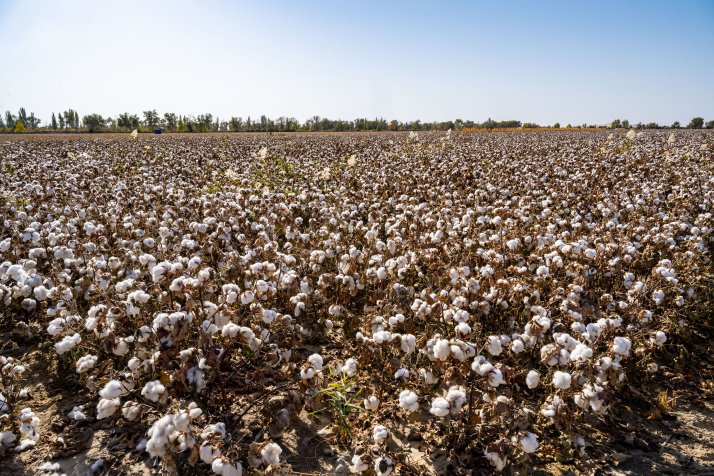 Cotton fields in Yuli County, Bayingol Mongolian Autonomous Prefecture, on October 25, 2023 (VCG)
A gateway for cooperation Several SCO member states lie at the heart of Eurasia and share close geographical, economic and cultural ties with Xinjiang. Long a bridge between China and Central Asia, the region is extending those historic connections into the digital cooperation. Xinjiang currently has 19 ports open to global trade and three regional multinational communications gateways. According to the Xinjiang regional government, it has also established 28 cross-border international optical-fiber links connecting it with Central Asia. But connectivity is only the starting point. Digital cooperation also depends on whether technologies can be adapted to local industries and whether technical standards and business practices can work across borders. This gives Xinjiang a role distinct from China's eastern technology hubs. While coastal regions are home to dense clusters of digital companies and research institutions, Xinjiang can serve as a testing ground and bridge—customizing mature technologies to meet the specific demands of Central Asian markets. The China (Xinjiang) Pilot Free Trade Zone adds another layer of support. Its institutional innovations are intended to facilitate cross-border digital trade and the implementation of digital projects, providing a policy framework for cooperation to move beyond discussions and into business activity. Where technology meets demand Some of these connections are already taking shape. The Xinjiang Integrated Space-Air-Ground Laboratory and the Xinjiang International Integrated Computing Center are partnering with counterparts in Kazakhstan, Uzbekistan and Tajikistan to build a satellite Internet network. Its remote-sensing data can be used for cross-border energy monitoring, smart agriculture and ecological disaster prevention. Agriculture offers another window into how such cooperation can work. Yuli County is home to China's first unmanned cotton farm established in 2021. Two managers born in the 1990s oversee the 200-hectare "super cotton field," using agricultural drones, the Internet of Things, AI and a smart farm management system to automate much of the planting, cultivation and harvesting process. After several growing seasons, the farm has raised cotton yields from about 3.8 tons to more than 7.5 tons per hectare, while reducing labor, water, fertilizer and pesticide use. This year, unmanned seeders guided by China-developed BeiDou navigation satellites have been used for precision planting, with techniques such as dry sowing followed by drip irrigation to improve efficiency. About 75 percent of the farm's management tasks are now handled without human intervention, with water, fertilizer and pesticides controlled through an intelligent system. According to Ai Haipeng, one of the farm's managers, the model is being rolled out across Xinjiang, covering more than 2,500 farms and over 133,000 hectares of cotton fields. A similar approach is being explored in Kuerle (Korla), where the Cloud Farm project uses smart irrigation to address fragmented farmland, water shortages and the high cost and complexity of adopting smart farming technologies for individual households. The project consolidates scattered plots without changing farmers' land use rights and applies lightweight technologies such as AI-powered water and fertilizer management and low-flow drip irrigation. The results are measurable. Compared with conventional farming, the demonstration fields have cut average water use from 12,000 cubic meters to 4,200 cubic meters per hectare, while raising cotton yields from 5.25 tons to 7.8 tons per hectare. These are not abstract technologies. They have grown out of Xinjiang's own agricultural conditions. For Central Asian countries with similar agro-climatic profiles, such solutions offer replicable pathways for adapting China's digital farming technologies to local needs. Here, discussions on digital cooperation are grounded in the markets, industries and real-world applications they are intended to serve. From east to west The gap in digital development across the SCO also opens up room for cooperation. China has accumulated capabilities in areas such as computing, satellite remote sensing and industrial digitalization, while Central Asian markets are looking for technologies that can be adapted to local conditions and deployed at scale. Xinjiang's proximity to Central Asian markets makes it an ideal testing ground for piloting applications and gauging demand, while the insights gained can feed back into the development of digital infrastructure, services and governance in the region. For Chinese digital companies, this offers a shortcut to Eurasian markets. The forum's agenda reflected this broader approach. Its four parallel sessions focused respectively on digital connectivity, digital trade and corridor economies, digital-intelligent industrial applications, and digital governance and capacity building. The organizers also arranged field visits to 13 sites, covering cross-border trade, smart logistics, green computing and specialty industries. Building the next layer Xinjiang's own digital infrastructure is expanding alongside its growing role in cross-border cooperation. By the end of July, the region's installed renewable-energy capacity had exceeded 174 million kilowatts, with six renewable-energy bases each exceeding 10 million kilowatts. This provides a foundation for the development of green computing. In the Urumqi Economic and Technological Development Zone, two A-level general-purpose computing data centers have been put into operation, with total deployed computing capacity reaching 1,021 petaflops. The combination of abundant renewable energy and growing computing capacity could give Xinjiang a new role in the regional digital economy: providing lower-carbon infrastructure for data-intensive industries and emerging AI applications. But the more immediate test is whether these capabilities can translate into cross-border projects. Ahead of the forum, participating countries compiled more than 200 digital economy cooperation cases and identified over 150 priority areas for cooperation. During the forum, nearly 20 cooperation intentions were reached for the 2026-27 period, covering digital infrastructure, agriculture, manufacturing, energy, transport, education and healthcare. For Xinjiang, the significance of the forum may ultimately lie less in the volume of discussions than in what follows. The region already has the infrastructure, applications and cross-border links to pilot new forms of cooperation. The next measure of its digital role will be how many of those connections turn into viable cross-border projects. Comments to kangcaiqi@cicgamericas.com |
|
||||||||||||||||||||||||||||
|