
|
| Xinjiang Today |
| A princess from the plains | |
| The Han princess who forged early connections in the northwest | |
|
|
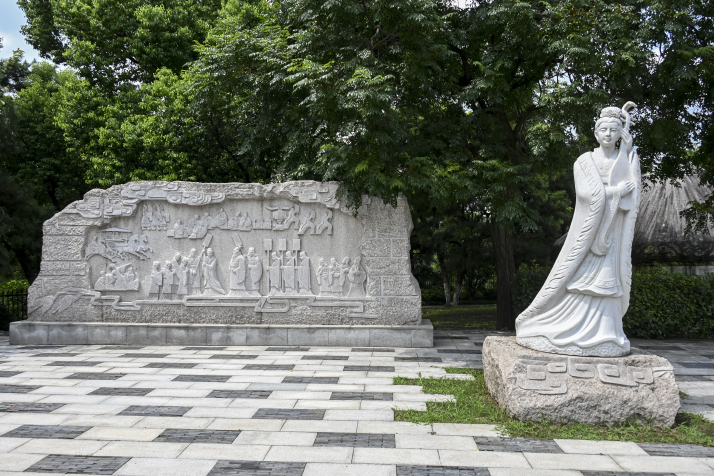 A sculpture of Liu Xijun at the Yangzhou Museum of King of Guangling's Tomb in the Han Dynasty (206 B.C.-A.D. 220) in Yangzhou, Jiangsu Province, on August 29, 2024 (VCG)
At the entrance to the Xiata Scenic Area in Zhaosu County, Yili (Ili) Kazak Autonomous Prefecture, there is a tomb nearly 10 meters high and 40 meters long at its base, one of the largest ancient graves on the Wusun grasslands. It is the burial site of Princess Liu Xijun of the Western Han Dynasty (206 B.C.-A.D. 25). Her statue stands roughly 500 to 600 meters from the tomb.
Liu was born in the Central Plains, the heartland of ancient China that covered the middle and lower reaches of the Yellow River. In 105 B.C., the 16-year-old princess was sent to marry the king of Wusun, ruler of a state in the Western Regions, roughly today's Xinjiang. Five years later, she died of illness. Liu not only brought advanced farming and silk weaving techniques, but also built a bridge of friendship between the Western Han Dynasty and the Wusun state. Though her life was short, Liu's unique historical position made her a symbol of the early blending of Central Plains and Western Regions cultures. Her deeds are still praised by local people today and have become a poignant historical memory for the grasslands.  The Xiata Scenic Area in Zhaosu County, Yili (Ili) Kazak Autonomous Prefecture, on July 27, 2021 (VCG)
A tragic childhood Liu Qi, known as Emperor Jingdi of the Western Han Dynasty who ruled from 157 to 141 B.C., had 14 sons. His fifth son, Liu Fei, was enfeoffed as King of Yi, with his fiefdom in what is today's Yangzhou, Jiangsu Province. Though talented, Liu Fei was short-lived. His prominence led to him being suspected by the empress and he lost favor. Subsequently, he fell into a life of dissipation and pleasure, dying at just 27 and leaving behind a son named Liu Jian. Liu Jian inherited none of the better qualities of his father's early years, but thoroughly surpassed him in the worst excesses of his later years. Even before his father was laid to rest, Liu Jian committed acts of debauchery with his father's favorite consorts. The Book of Han, the official chronicle of the Western Han Dynasty from 206 B.C. to A.D. 23, records further cruelties: He once capsized a boat for amusement, drowning two women, and on another occasion laughed as two attendants drowned. Knowing he was widely hated and fearing execution, Liu Jian later decided to rebel, but the plot was exposed and he committed suicide. After Liu Jian's death, the fiefdom of the King of Yi was taken back by the court and became Guangling Prefecture. Liu Xu, the fourth son of Emperor Wudi, son of Emperor Jingdi whose reign lasted from 156 to 87 B.C., was enfeoffed as King of Guangling. Liu Xu sent members of his court to seek out Liu Xijun, Liu Jian's only daughter, who as a child had been left to wander the streets, and took her in as an adopted daughter. Made a princess Liu Xijun thrived in her new environment, and Liu Xu treated her equally with his own children. According to the Book of Han, Liu Xijun was delicate and gentle, fair and beautiful, intelligent and clever, able to compose poetry and write prose. She was also proficient in music and good at playing the pipa, a four-stringed, pear-shaped Chinese lute. It can be seen from the records that she lived happily in her uncle's home. In 139 B.C., Emperor Wudi sent diplomat Zhang Qian from the Central Plains on a mission to the Western Regions. After 13 years, Zhang returned with invaluable information about the lands and peoples, opening the Silk Road and establishing first lasting connections between the two regions. According to the Book of Han, "Wusun, ruled by the Great Kunmi from Chigu City, lies 8,900 li (roughly 4,500 km) from Chang'an (capital of the Western Han Dynasty in today's Xi'an, Shaanxi Province). It had 120,000 households, a population of 630,000 and could mobilize 188,800 warriors." The Wusun were nomads who followed the herds to pasture and water, and they shared customs with the Xiongnu. The Xiongnu was a nomadic tribe that made its first appearance in north Eurasia in the third century B.C., migrating westward in the second century before vanishing in the fifth century. The people of Wusun were rich in horses, with the wealthier owning up to 4,000 or 5,000. Described as bold, fierce, greedy and untrustworthy, they frequently engaged in raiding, which had made them the largest and most powerful of the 36 states of the Western Regions at that time. The Xiongnu people frequently launched raids on both the Western Han Dynasty and Wusun, prompting an alliance strategy between the two sides through marriage. The king of Wusun then offered a betrothal gift of 1,000 horses to marry a Han princess. By then, however, the Han court was already well acquainted with the Western Regions, particularly with the stark contrast between the barrenness of Wusun and the richness of the Central Plains. Unwilling to let his own daughter be married so far away, Emperor Wudi instead turned to the wider imperial clan for a suitable candidate. After much deliberation, Liu Xijun fell under the emperor's gaze. Emperor Wudi was well aware of this adopted daughter of his fourth son. As the biological daughter of a convicted member of the imperial clan, Liu Xijun had no powerful patron behind her and no one would speak up on her behalf. Her adoptive father could also curry favor with his imperial father by surrendering her, so he was only too willing to do so. Liu Xijun was elevated to the status of princess and sent in marriage to Liejiaomi, King of Wusun, in 105 B.C. According to the Book of Han, upon her departure for Wusun, Emperor Wudi granted her imperial carriages, garments and household articles, and arranged for an entourage of several hundred officials, attendants and guards. To leave her native land and marry far away, to go to a place where the language was unintelligible and the customs utterly different, how conflicted Liu Xijun must have been. Her escort traveled all the way from the Hexi Corridor, a 1,000-km narrow stretch of navigable plains spanning today's Gansu Province and a key segment of the ancient Silk Road, to Dunhuang, out through the Yumen Pass, by the city of Loulan and finally over the Tianshan Mountains. The journey took more than a year, crossing thousands of mountains and rivers before the procession finally arrived in Wusun. From then on, this beauty of the Central Plains took on the historical mission of nurturing goodwill between the Western Han Dynasty and Wusun and of sustaining their alliance against the Xiongnu, and so began her brief days on the grasslands, marked by both love and sorrow. Death and legacy When Liu Xijun arrived, the Wusun received her with the highest ceremony. Historical records say that in Chigu, Wusun's capital, officials and common people on both sides of the main road played musical instruments, sang and danced. Struck by the princess's delicacy, gentleness, fairness and beauty, Liejiaomi was delighted and granted her the position of Right Madame, a title for a high-ranking consort. Liejiaomi was over 70 years old, white-haired and decrepit. Liu Xijun did not live with him, but, as historical records state, governed her own palace quarters and lived there. The so-called palace quarters were merely the tents of the nomadic people, with domed rooves and felt walls. The couple could not understand each other's language and had little to say to one another. Liu Xijun met Liejiaomi only a few times a year. She would bestow the silk textiles and other valuables she had brought with her on the people around Liejiaomi, which was also for the purpose of sustaining the alliance between the Western Han Dynasty and Wusun. What gave the princess a headache was the palace intrigue at the Wusun court. The Book of Han records that when the Xiongnu learned of this marriage alliance, they too sent a woman to marry Liejiaomi, and the king enfeoffed her as Left Madame, a consort title ranking above Liu Xijun's. To win Liejiaomi's favor, the two madams often vied with each other, both openly and behind the scenes. This was not the life Liu Xijun wanted and she lived all day in gloom. In 103 B.C., she wrote a poem, lamenting her homesickness. When Emperor Wudi heard of it, he felt pity for her and sent envoys to deliver some Central Plains specialties, such as curtains and brocade, as a token of his regards. Liejiaomi died in 103 B.C. and his grandson Junxumi succeeded to the throne. According to Wusun custom, the Han princess was required to marry the heir. This made Liu Xijun, who had been educated since childhood with the ethical traditions of the Han, feel even more humiliated. She submitted a memorial to Emperor Wudi requesting permission to return home. But Emperor Wudi replied that she should "follow the customs of Wusun, as I wish to join with them to destroy the Xiongnu." Helpless, the princess had no choice but to marry Junxumi. In 102 B.C., she gave birth to a girl. Because of a postpartum disorder and unrelieved sorrow, she fell ill and could not rise from bed. With the turn of 101 B.C., Chang'an was filled with a sense of peace. Officials paid homage, the people offered sacrifices and all was unusually lively. Yet it was precisely at this moment that Liu Xijun died of illness. It is unknown whether Emperor Wudi, her adoptive father Liu Xu or even Junxumi mourned her passing. For from the Book of Han one sees only a single cold sentence that after her death, Emperor Wudi married another princess to Junxumi. More than 2,000 years later, a complex of buildings in the ancient Han style was erected in Yining and named the Memorial Hall of Han Princesses. It chiefly commemorates the history of the two princesses marrying into Wusun. Various artifacts, wax figures and sculptures vividly illustrate the exchanges between the Western Regions and the Central Plains at that time. The fragments of silk textiles and the reconstructed ancient objects displayed in the cases tell of that intercultural dialogue that spanned a vast distance, becoming a historical window bearing witness to the Western Han Dynasty's governance of the Western Regions and its efforts to advance ethnic integration. Through these exhibits, one seems able to travel through time and space and feel how Liu Xijun, this delicate woman, struggling to hold her ground in the fissure between the greater good of family and state and her own personal fate. Comments to lanxinzhen@cicgamericas.com |
|
||||||||||||||||||||||||||||
|