
|
| Xinjiang Today |
| Around Xinjiang, homestays are turning strangers into friends | |
|
|
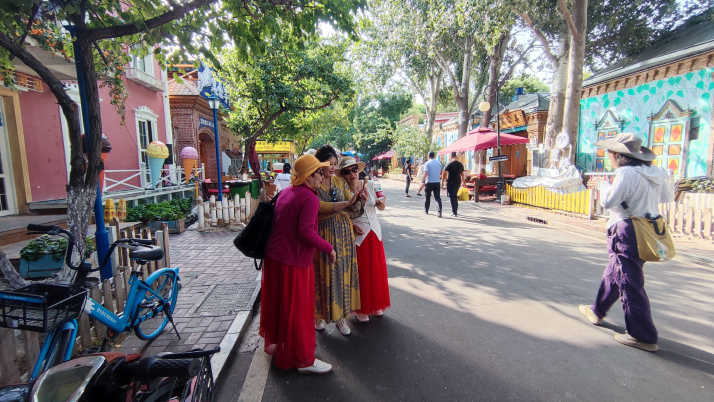 Tourists take a selfie on Liuxing Street, a famous tourist site in Yining, Yili, on September 8, 2025 (LU YAN)
In 2020, Ma Yan and her husband Liu Xiong converted idle space in their home into Yunhua Residence, the first homestay in Bayandai Village in Yili (Ili) Kazak Autonomous Prefecture. They named it Yunhua Residence (Cloud and Flower Residence). As its name suggests, the small courtyard homestay is filled with flowers and other plants that Ma planted herself. Greenery spills from pots along the walls and pathways, and the courtyard shifts with the seasons: fresh leaves in spring, shade in summer and warm colors in autumn. Inside, almost every piece of decor was chosen by Ma and Liu themselves, one item at a time. Rather than following a designer's plan, she picked things she liked as she came across them: simple furniture, handmade textiles, small ornaments and keepsakes that give each room its own character. The courtyard also carries a distinctly Xinjiang flavor. Colorful rugs and cushions, patterned fabrics and handcrafted pieces echo local traditions. At first, almost all the guests at the homestay were from other parts of China. To make them feel comfortable and help them eat well in her home, Ma would always ask ahead of time about their food preferences, noting down whether they favored spicy or mild flavors and whether there were any ingredients they avoided. "Being able to make friends from all over the country or even the rest of the world is the greatest wealth and the best gift," Ma told Xinjiang Today. Across Xinjiang, homestays like Ma's are doing more than helping local families earn extra income. They have also become windows through which visitors from elsewhere can learn about Xinjiang's culture, folk customs and society, offering a firsthand look at everyday life in villages around the region. 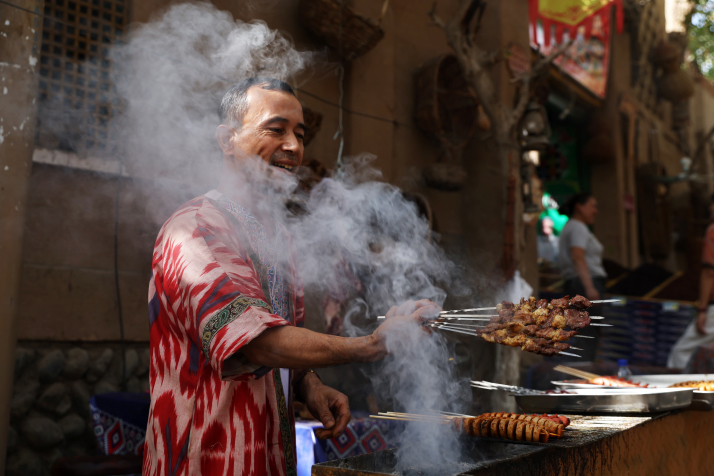 A local vendor grills mutton skewers at the Grape Valley scenic area in Tulufan (Turpan) on September 10 (CNSPHOTO)
A courtyard that feels like home These guests staying in her home get to eat food made by Ma herself every day. "We raise chickens and sheep at home, so we make Xinjiang specialties like dapanji, or Big Plate Chicken, as well as lamb and smoked beef," Ma said. "To me, guests are family." Ma's homestay is near the local rural library, Wang Meng Reading Room, which is dedicated to Wang Meng, a preeminent Chinese author who worked in Xinjiang for years and created famous works on the region. The homestay has eight rooms and can host about 20 people. In their spare time, guests sit in the courtyard with Ma and her husband, and Ma tells them about how Wang, the author of the collection of novels on life in Yili, once studied Uygur on his own in Bayandai and worked, lived and studied alongside local villagers. The guests, in turn, share stories about the cities where they live. Every year in June, July and August, the homestay is almost fully booked every day. Some guests are drawn by the local customs and culture of Bayandai—the living traditions of food and festivity, from meat naan baked in earthen pits to the aroma of milk tea lingering in courtyard homes. Others come with a clear purpose, calling out warmly as soon as they walk in, "Hello, Sister Ma!" Hearing this, Ma always smiles knowingly. She knows these are new guests introduced by "old friends." Over time, many people who have stayed at Ma's home have not only become good friends with her and often send local specialties, but also invite Ma and her husband to visit them: "Come, and I'll be your driver." A single homestay has become a window for exchanges. Tourism businesses like the homestay run by Ma and her husband have also been quietly driving the development of Bayandai. Today, Ma helps other villagers make use of their idle homes and create homestays with distinctive features. One household after another is opening a small courtyard homestay. "People's lives are getting better day by day, and the village is becoming livelier as well," Ma said. 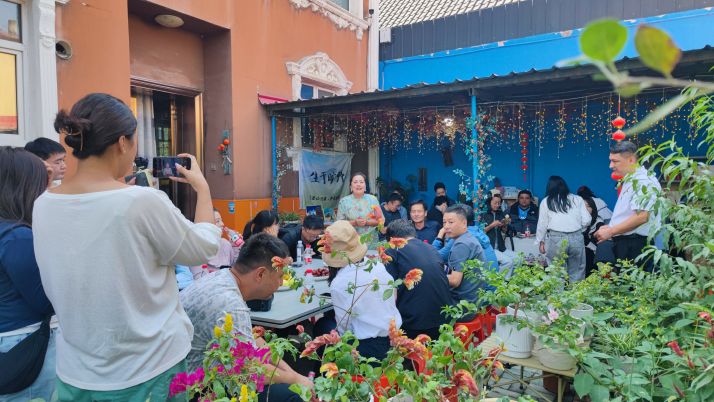 Ma Yan (center) and her husband Liu Xiong, homestay operators in Yili (Ili) Kazak Autonomous Prefecture, welcome guests at their homestay on September 8, 2025 (LU YAN)
The bigger picture According to statistics from Xinjiang's cultural and tourism authorities, by the end of 2024, Xinjiang had more than 6,600 homestays offering roughly 110,000 beds. Government policy has been a major force behind this boom. Take Cocodala, a county-level city in northwest Xinjiang, as an example. Local authorities have handed out 118 million yuan ($17.6 million) in dedicated homestay loans, paid over 3.5 million yuan ($522,700) in culture and tourism incentives and subsidies in 2025, and run regular homestay manager training programs, organizing industry workers to visit and learn from places that have developed mature tourism industries. The changes brought by homestays go far beyond accommodation itself. In Kaladala Town in Yili, some 300 herding households have shifted to running homestays, shops or tour vehicle fleets, with more than 1,000 farmers and herders now working in tourism, a 25-percent boost in local employment. In Aliwengbai New Village, Boertala (Bortala) Mongolian Autonomous Prefecture, 16 homestays directly employ more than 160 people in total, and indirectly support other jobs in the food and beverage industry, as well as in cleaning and agricultural product sales. More importantly, homestays are becoming places where visitors actually learn about local culture. On Liuxing Street in Yining, Yili, people host salons with intangible cultural heritage practitioners, where guests can hear chakchak, a Uygur traditional oral joke art form, and watch embroidery. In Kuerdening Township in Gongliu County, herders open their homes to visitors, singing for them and talking about Kazak culture. "We don't want a homestay to be just somewhere you sleep," Ma said. "We want it to be a place where you feel the pull of the culture." In addition to local entrepreneurs like Ma, younger people born in Xinjiang are choosing to return home to open homestays. Zhang Siqi from Zhaosu County in Yili quit her job elsewhere and went back in 2018, converting her family home into a homestay and becoming one of Zhaosu's first homestay entrepreneurs. Her homestay isn't just a place to sleep; she also designs itineraries, so that her guests get more out of their trip. One interesting trend is that many homestay owners were once tourists themselves. In Grape Valley, a renowned scenic area in Tulufan (Turpan), Shang Dongxin, founder of the Afanti Character and Style Garden, first came to Tulufan on a trip, fell in love with the place, and made the leap from sightseer to tourism entrepreneur. He rented an old courtyard home and renovated it with preservation in mind. Also in Grape Valley, Zhang Kai, a 55-year-old man from Chongqing, visited with his family in 2018. He went back in 2023 to open a homestay. With years of experience in industry, he even helped his neighbor start a restaurant, turning what began as strangers into neighbors "as close as family." Growth this fast comes with problems, of course. The season is short and costs are high, and some places simply shut down for the winter, the industry is going through a shakeout. But the courtyards run with real care, like Ma's, are still packed every day at peak season. Brick by brick, meal by meal, they turn strangers from far away into old friends. (Print Edition Title: Brick by Brick, Meal by Meal) Comments to luyan@cicgamericas.com |
|
||||||||||||||||||||||||||||
|