
|
| Xinjiang Today |
| A humble naan baker becomes an unlikely social media sensation | |
|
|
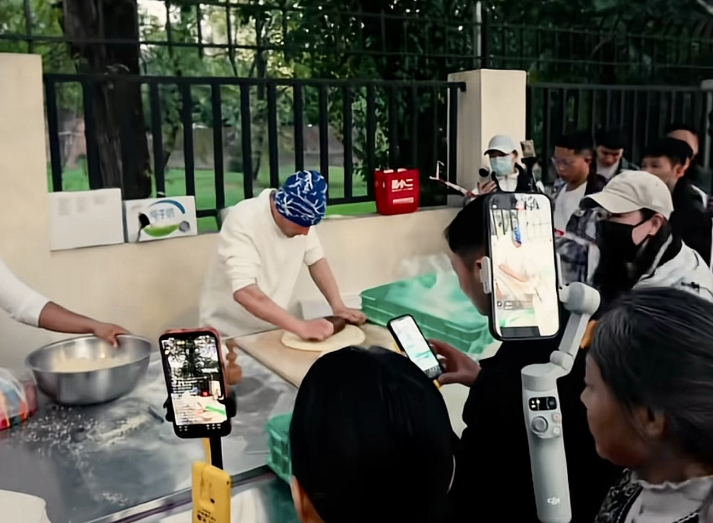 A screenshot from Douyin shows Naisireding Rexiti working behind his counter, surrounded by onlookers and livestreamers (SCREENSHOT)
The heat strikes first, rising in shimmering waves from the narrow mouth of the clay oven. Then comes the rhythmic thud of hands on dough: slap, fold, roll, slap… Standing behind a custom-built mobile baking cart on a corner in Xi'an, the capital city of Shaanxi Province, Naisireding Rexiti works in near-total silence. His arms move with a steady, practiced intention. He rolls out a heavy circle of dough enriched with milk and egg, scatters a dense layer of white sesame seeds across its surface and stamps it with a floral punch. A crisp thwack echoes as he slaps the wet disk directly against the white-hot inner wall. Moments later, using a long, slender iron hook, he pulls out a finished naan bread—golden, steaming, over 40 cm wide and weighing nearly 1 kg. Across the skin of his forearms lies a geography of pale, thin scars: the occupational map of a man who has spent half his life reaching into fire. He is practicing an art with roots that run deep into history. Recognized today as a form of national intangible cultural heritage, naan-making dates back roughly 2,000 years to the ancient Silk Road. Two millennia later, Naisireding's daily routine keeps that heritage alive. Directly across from his small workstation, the quiet focus of his craft gives way to a sprawling wall of noise. Beyond his stall, a queue stretches down the block, where customers wait up to five hours for a single circle of bread. There are local retirees in heavy coats, university students clutching umbrellas, mothers holding sleeping infants and dozens of content creators holding smartphones aloft on selfie sticks, their screens pulsing with real-time comments. They have all come to see "Adaxi"—the Uygur word for brother or friend, and the affectionate nickname local residents and millions of online viewers have bestowed on this quiet baker from Kashi (Kashgar). 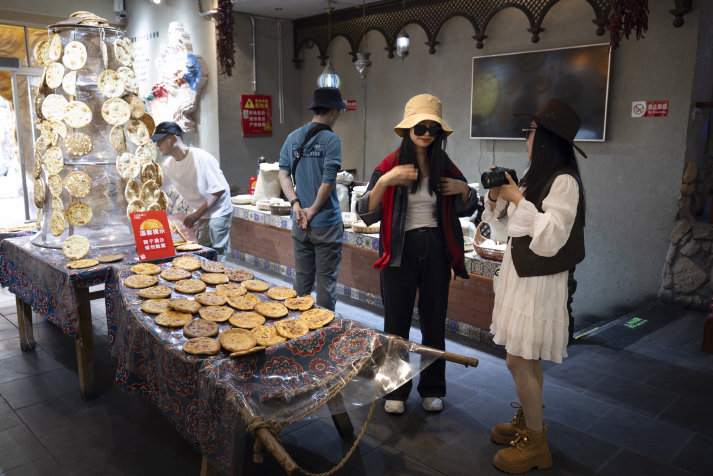 Tourists visit the naan-themed museum inside the Xinjiang International Grand Bazaar in Urumqi on September 14 (VCG)
A craftsman's code Born in Kashi, Naisireding grew up accustomed to hard work. His father died when he was young, leaving his mother to support the household through farming. As the youngest child, he set out early to learn a trade that could help support his family. He traveled between Kashi, Shihezi and Urumqi, serving years of apprenticeship under master bakers until his technique was refined. In February 2023, carrying his savings, he left Xinjiang for the first time. He spent 12,000 yuan ($1,680) to build a specialized mobile baking cart and moved more than 1,500 miles east to Xi'an, the historic eastern terminus of the Silk Road. His first days were tough. Unaccustomed to the fast pace of the city and too shy to shout out to passersby, he earned just 30 yuan ($4.47) on his first day. But he refused to compromise on his ingredients. He stuck strictly to the traditional recipe of his hometown, incorporating milk, eggs, yeast and generous handfuls of sesame seeds. For four years, Naisireding's business model was as straightforward as it was generous: hot, fresh Xinjiang flatbread for 4 yuan apiece ($0.55), or three for 10 yuan ($1.4). One bread was large enough to feed an entire family for dinner. Prices never rose, and the quality never wavered. Then, in October, a video capturing his unvarnished work ethic went viral on short-video platforms. Within 48 hours, his quiet corner became an epicenter of activity, as he became a micro-celebrity. Yet inside the online frenzy, Naisireding rarely raises his head. While talent agencies and digital marketers descended on his cart offering to manage his accounts and commercialize his image, he politely turned them away. "Baking naan is baking naan," he said quietly through an interpreter as his Mandarin is limited. "If you spend all your time filming, the bread gets cold." His standard of quality remains uncompromising. Any bread that cracks in the pit or scorches along the bottom is pulled from the selling stack. Rather than discarding them, Naisireding tears the hot, imperfect flatbreads into thick pieces by hand, passing them out to waiting customers and neighbors for free. As the crowds swelled, the physical demands became overwhelming. Working up to 12 hours a day—from morning dough prep through long afternoon and evening baking shifts—Naisireding's routine left little room for rest. Observing his exhaustion, a web of regional solidarity formed around the stall. Relatives flew in from Xinjiang to help knead dough and organize the queue. Alimu Niyazi, an agricultural business owner from Xinjiang, drove to the stall to donate 200 bags of specialty flour. "I wanted to thank him," Alimu told China News Service. "Through his honest work, he is showing people across China the warmth, sincerity and diligence of Xinjiang people." Longtime customers have also stepped up to help. Tang Yong, a local resident who has bought bread from Naisireding for over a year, spends his evenings directing traffic around the stall. "A year ago, he set up right under my apartment," Tang told Jinan Daily. "Waiting time in the line was 20 minutes at most. He didn't talk much. Whatever you said to him, he just smiled, nodded and went back to baking. Becoming famous hasn't changed him at all, but we worry about his health." 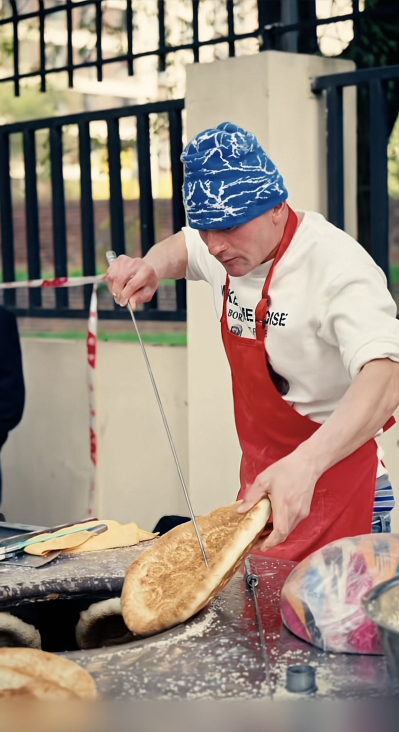 A screenshot from Douyin shows Naisireding Rexiti pulling a fresh naan from his clay oven with a long iron hook (SCREENSHOT)
The digital tide For days, Naisireding actively resisted the pull of social media. He repeatedly turned down offers from digital agencies to set up accounts or record videos. All he wanted, he insisted, was to focus on the dough in front of him. But as the sidewalk outside his cart swelled into a perpetual media circus, the digital world inevitably breached his quiet sanctuary. On the evening of October 23, with the help of a local Xi'an resident, his elder brother launched an extended livestream directly from the stall, drawing more than 215,000 viewers who tuned in just to watch the family knead flour and tend to the clay oven. A day later, on October 24, Naisireding finally relented, posting his very first short video on Douyin with a simple promise to share his daily routine. Within two weeks, his follower count surpassed 60,000. Media scholars note that public fascination with Naisireding reflects a broader cultural trend in China, where audiences increasingly seek out stories of unpretentious, hard-working individuals amid an era of hyper-commercialized Internet media. "In a fast-paced digital environment, people naturally gravitate toward stories with genuine human warmth," Xu Peixi, a professor at the Communication University of China, told ThePaper.cn. "It touches a collective desire for something real." (Print Edition Title: Fire, Flour and Flame) Comments to yuanyuan@cicgamericas.com |
|
||||||||||||||||||||||||||||
|