|
| China |
| Stronger legal protections, smarter time management and a cultural shift from "always on" to "fully alive" | |
|
|
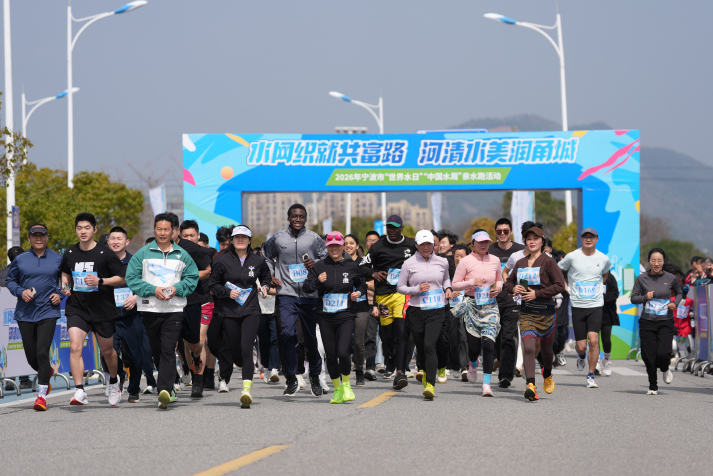 Running enthusiasts participate in a race for World Water Day and China Water Week in Ningbo, Zhejiang Province, on March 20 (XINHUA)
For He Feng, a 32-year-old programmer in Beijing, working out has always been a habit. But with a demanding job that often keeps him at the office until 10 p.m., he struggles to maintain a consistent fitness routine. Still, he insists on lifting weights once he's home. He initially thought that as long as he kept exercising, he could offset the physical toll of his high-pressure job. Recently, however, he's begun to rethink that belief. The reason: the sudden death of Zhang Xuefeng. Zhang was a well-known postgraduate entrance exam tutor in China, famous for his sharp, humorous and story-driven teaching style that went viral online. Over the years, he advised millions of students on their academic and career paths. On March 24, the 41-year-old education consultant suffered a sudden cardiac arrest when exercising on a treadmill, and died shortly after. In life, he took pride in having run marathons, and once even joked about the topic of sudden death during a livestream. At the time, most viewers laughed it off. But when the tragedy unfolded in such a devastating way, countless people began to reexamine their own bodies and lifestyles. "The night I saw the news, I was shocked and had a hard time falling asleep," He told Beijing Review. "A guy who could run a marathon, someone who looked way healthier than me, was gone—just like that. I suddenly realized that my idea of 'exercise cancels out overtime' was probably just some kind of psychological comfort." He's unease is far from unique. Zhang's death triggered not only mourning but also a collective reckoning with the realities of China's workplace culture. Many netizens expressed a mix of grief, fear and self-reflection, sharing their own stories of late-night work and health struggles, including mental health problems and even burnout. Suggestions for mandatory rest have also gained traction online. A personal awakening is quietly taking place across the country, with people rethinking their work-life balance.
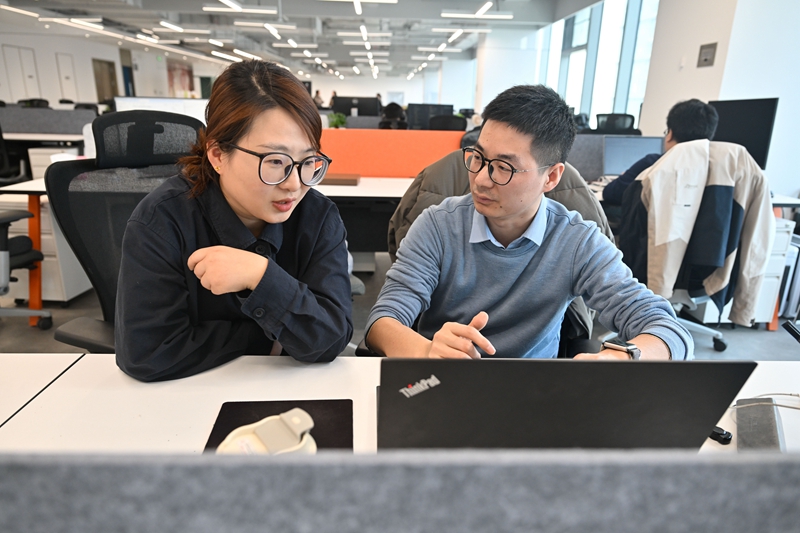
Professionals at work in a technology company in Nanjing, Jiangsu Province, on March 12 (XINHUA) Blurred boundaries Today, countless professionals are facing tight work schedules that result in a lot of stress. With the spread of smartphones and instant messaging tools, the traditional notion of "clocking out" has basically gone extinct. He never leaves home without a backpack carrying his laptop—just in case work calls. "When I was on vacation last year, my boss called about a project issue. I immediately pulled out my laptop at the train station and started working on the spot," He recalled. He added that after work or on weekends, it's common to receive work messages on instant messaging apps such as DingDing and Weixin. According to a recent survey jointly conducted by newspaper China Youth Daily and survey portal Wenjuan.com, 77.5 percent of the 1,335 respondents across China feel the boundary between their personal and professional lives has become blurred. Specifically, 52.5 percent continue to respond to work messages after hours, 45.7 percent have canceled weekend plans due to work, 44.5 percent frequently receive work-related calls, messages or e-mails outside of working hours, 42.8 percent are suddenly notified to handle tasks during their time off, and 36.6 percent say they are constantly tagged in work group chats on their mobile devices. "I feel like I'm working at least two thirds of the day," Liu Hui, a 23-year-old postgraduate student who is currently interning at a company, told the newspaper. Even when she's off the clock, work messages and calls can come at any time. "So my mind is always on work, even during breaks. Work casts a long shadow over my life," she said. Liu added that for her parents' generation, when they left work, they were truly off duty. They could focus on their own lives. But society has sped up, and social media has freed work from the constraints of time and space." Qi Xiao, a copyeditor in Huizhou, Guangdong Province, feels that today's social environment has blurred the line between work and life, especially for young people in big cities. "The pressure is high, and they're mentally tense, afraid to relax," Qi told China Youth Daily. On a personal level, she added that some young people don't know how to say no, which often leads to them taking on extra work and further shrinking their personal time. Why is the boundary between work and life becoming increasingly unclear? According to the survey, 68.1 percent say instant connectivity has dulled their sense of distinction, while 55.8 percent believe new technologies have eroded the traditional eight-hour workday. Meanwhile, 38.1 percent admit that limited personal capacity leads them to bring work home, and 29.4 percent acknowledge that they willingly sacrifice rest time in pursuit of professional achievement. Zhang Baoyi, a researcher at the Tianjin Academy of Social Sciences, offers a broader perspective. He noted that the fixed nine-to-five work schedule originated in the early days of industrialization, designed to accommodate assembly line production. But people have different periods of peak focus, and the traditional model may not fully tap into individual motivation or creativity. With technological advances, flexible work arrangements are the way forward, and workers should be given more autonomy over their working hours. Zhang Baoyi argued that achieving a work-life balance is one of the most important challenges facing today's workforce. "The goal of both work and life is to realize one's self-worth," he told China Youth Daily. "In essence, the two are not in conflict." He advises professionals to recognize how work and life complement each other, align their career goals with their personal aspirations, and find a rhythm that truly suits them.
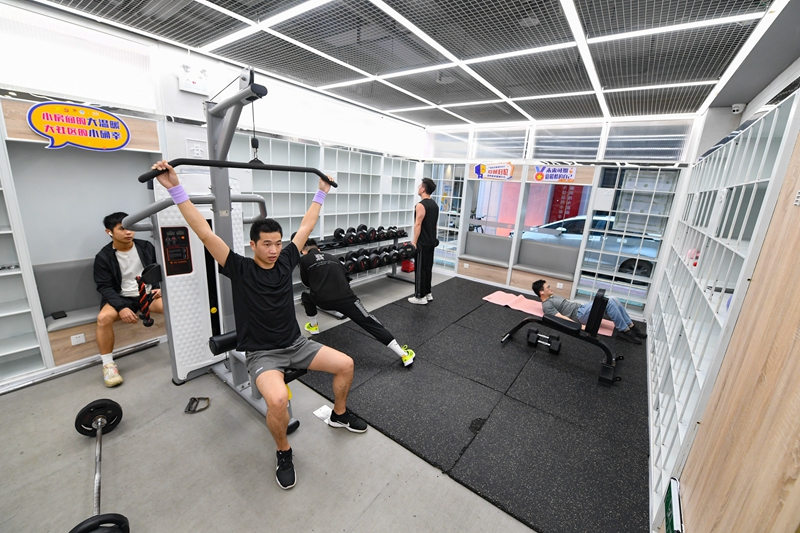
A gym in a residential community in Shenzhen, Guangdong Province, in April 2023 (XINHUA) Finding the rhythm Different people find different ways to balance the professional and personal spheres. He, for one, hasn't given up on exercise. He's just become smarter about it. He no longer forces himself to work out every single day. Instead, he fits in moderate workouts whenever possible. Beyond the gym, he fills small gaps in his day with low-stress activities—reading, shopping online or listening to podcasts. "I think we need to accept that work and life are blending together," he said. "That trend isn't going away. What we have to do is adapt, enjoy life while we're working and work efficiently." In Changchun, Jilin Province, yoga instructor Cheng Cheng has noticed a shift. As spring has arrived and the weather is warming up, more and more people are signing up for her classes. "When it's cold outside, people tend to bury themselves in work and stay home," she told Beijing Review. "But when it gets warmer, they remember they have bodies that need to move, and lives that need to be lived." For many of her students, she added, the yoga mat has become a rare space where phones are silenced, notifications are ignored and the boundary between work and life is deliberately, if only briefly, restored. Liu, for her part, has yet to find her own balance between the professional and the personal. "It's really hard for me," she admitted. "You always have to give up one thing to gain some kind of completeness in the other." She acknowledged that work and life increasingly overlap, and that this seems to be the way of the future. But beyond individual adjustments, she believes companies also need to make a conscious effort to leave their employees more room for life. Policy support Workers' rights to rest and health can't depend on personal discipline or company goodwill alone—they need the kind of protection that only institutional guardrails can provide. Policymakers are already stepping up. In 2016, the National Health Commission launched the Healthy China 2030 plan, outlining public goals with a focus on disease prevention and health promotion. The plan reads that by 2030, the population's health literacy will be greatly improved, wholesome lifestyles will have become widespread, and a production and living environment conducive to good health will have largely taken shape. Released in March, a joint initiative involving the National Health Commission and 25 other government departments, the Implementation Plan for Improving the Social Psychological Service System and Crisis Intervention Mechanisms, explicitly sets the goal that by 2030, a social psychological service system and crisis intervention framework covering all residents across the full lifespan will be basically in place. By 2030, more than 80 percent of administrative villages and urban residential communities will have psychological counseling rooms or social work studios, as well as mental health services. Companies are also encouraged to set up such counseling services. Shanghai offers a concrete example. As part of its 2025 public welfare projects, the city built and improved more than 1,000 on-site break rooms for workers, with over 3,000 such rooms completed to date. These facilities are tailored to the needs of different job types, for example, a stress-relief room equipped with punching bags and a meditation area for those professionals in fast-paced positions. "Life is the foundation," Zhang Baoyi said. "Happiness is life's core pursuit, and work is an extension of that happiness. When work allows a person to feel their own value, that sense of achievement feeds back into their happiness in life. And when they feel happy in life, they can approach work with greater energy and fulfillment." Copyedited by Elsbeth van Paridon Comments to luyan@cicgamericas.com |
|
||||||||||||||||||||||||||||||
|