
|
| Xinjiang Today |
| A league built from passion | |
|
|
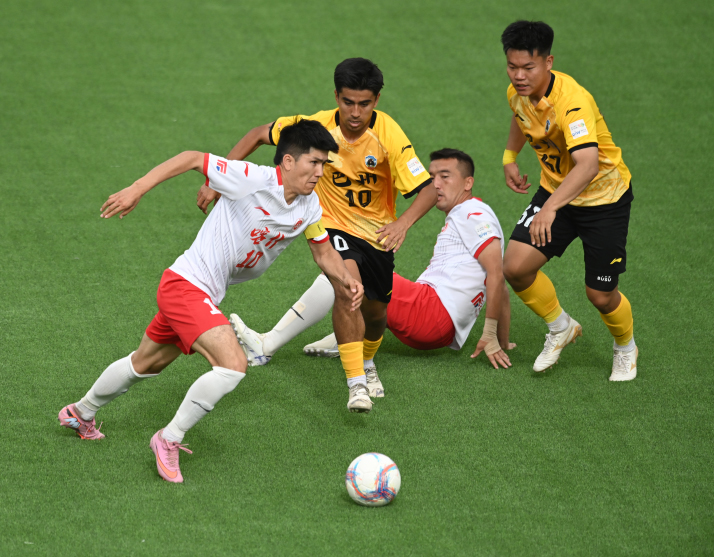 The Bayingolin Mongolian Autonomous Prefecture team takes on the Kashi (Kashgar) Prefecture team during the 2026 Tongxin Cup Xinjiang Super League in Kuerle (Korla), Bayingolin, on May 23 (VCG)
More than 5,500 spectators in Atushi (Artux), a city in Kezilesu (Kizilsu) Kirgiz Autonomous Prefecture, watched a match on May 17 that would enter Xinjiang Super League history. Just two minutes after kick-off, 22-year-old Kezilesu player Ruzeaji Aierken unleashed a sensational long-range strike from near the center circle, a "worldie" that brought the crowd to its feet. Goals of that quality are rare even in China's professional leagues. Members of the visiting Hami City team kept their composure, but Kezilesu converted a second-half penalty to seal a home victory and a winning start to the 2026 Tongxin Cup Xinjiang Super League.
The highlights soon went viral on Chinese social media, but the match's significance went beyond the scoreline. Nearly 1,800 km separate Hami, on Xinjiang's eastern edge, from Atushi in the west. Hami is famous for its namesake melons, while Atushi is known for figs, so the match quickly became nicknamed as the Fruit Bowl. The Hami team may have lost, but their traveling fans received a warm welcome from Kezilesu locals. "We were the visiting fans, but Kezilesu made us feel right at home," Hami supporter Maimaiti Simayi told Kezilesu media after the match. "I hope we keep this going—more matches, more connection between our two places. Figs and Hami melons are sweet on their own, but even sweeter together. That's the kind of friendship I hope we can share for a long, long time." Scenes like this have been unfolding across Xinjiang since May 16. That, in essence, is what the Tongxin Cup is about. "Tongxin," meaning "of one heart," speaks to the unity of Xinjiang's 26 million people across its various ethnic communities. The league's players come from 13 ethnic groups, and every squad includes members from at least three ethnic groups. On the pitch, they compete side by side, united by a purpose beyond victory. In the stands, fans from every background wave flags and cheer for their hometown teams. That shared passion transcends sport, strengthening community ties and giving Xinjiang's people another reason to build a future together. 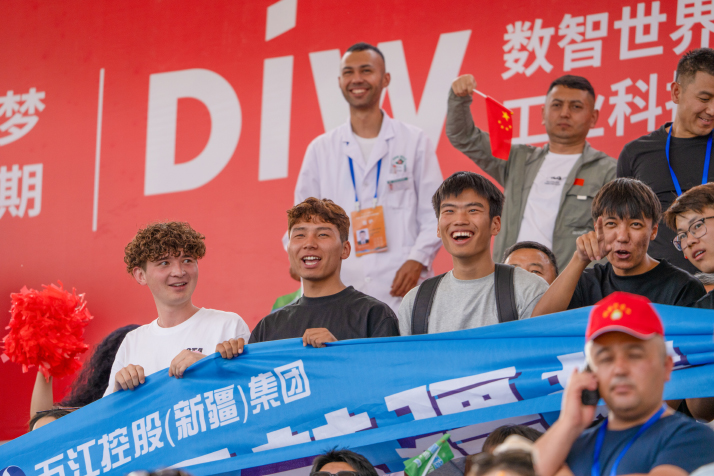 Fans cheer during Kezilesu's 2-1 home win over Hami in Atushi, Kezilesu Kirgiz Autonomous Prefecture, on May 17 (VCG)
A league of Xinjiang's own The template was set last year, when the Jiangsu City Soccer League, better known as the Su Super League, burst into the national spotlight. The model quickly spread, with more than a dozen provinces, including Sichuan, Hunan, Yunnan and Jiangxi, launching intercity soccer leagues of their own. In Xinjiang, though, it found especially fertile ground. Soccer has long been woven into everyday life here: The region has more than 1,100 schools with specialized soccer programs, and about 580,000 young people compete year-round. That passion is also feeding into the professional game. In the 2026 season, 28 players from Xinjiang were registered with 13 Chinese Super League clubs, China's top flight, while national teams at different age levels have seen a growing number of Xinjiang players, including Baihelamu Abuduwaili. Against this backdrop, Xinjiang's own soccer league was launched. "This is Xinjiang's first league of its kind and the region's highest-level mass-participation soccer event," Kang Yongxin, Deputy Director of Xinjiang's sports bureau, said at the April 29 press conference. "It is also a stage for people of all ethnic groups to take part and showcase their talent and spirit." Kang said the league is built around two ideas: reaching every corner of Xinjiang and bringing ordinary people into the game. The region's 14 prefectures and prefecture-level cities, along with cities of the Xinjiang Production and Construction Corps, have formed 14 teams. They are playing a 56-match season. The 490 players, aged 16 to 39, come from all walks of life, including farmers and herders, workers, students and delivery couriers. Matches are held on weekends. Tickets are priced at a uniform 9.9 yuan ($1.4), making it easy for local residents to get involved. In and around the stadiums, the league has turned soccer into a lively stage where people of all ethnic groups meet and mingle. Behind the scenes, the league has been run to the standards of a national competition. Match venues and backup sites have been assessed, procedures standardized, and leading specialists brought in to train staff through workshops and live drills. The result is a league with the warmth of community soccer and the discipline of the professional game. 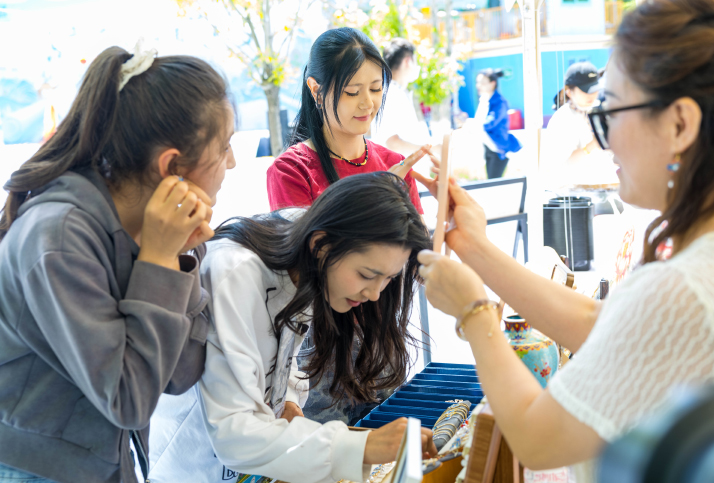 Residents in Urumqi experience intangible cultural heritage products on May 19 on the sidelines of the Tongxin Cup Xinjiang Super League (VCG)
A stage for soccer dreams Ruzeaji, whose spectacular strike lit up the opening round, is an Atushi native. Soccer runs in the family: His father is a coach, and Ruzeaji enrolled at a specialist soccer academy at 13 before going on to represent Xinjiang at China's 14th National Games. But his path to the professional ranks was anything but straightforward. Trials and brief spells with clubs in Henan, Yunnan and elsewhere never produced a stable contract, and at one point he came close to giving up on his soccer dream. Then came the Xinjiang Super League, giving players like Ruzeaji a stage to prove themselves. His wonder goal soon went viral across China. After the match, the 22-year-old, following four unsettled years away from home, watched the replay again and again. "As long as I've got a pitch and a ball, I've got a chance to prove myself," he said. "All those years of grinding weren't for nothing." Another fan favorite is Kaisaier Hasimujiang, a forward from Changji Hui Autonomous Prefecture. The 21-year-old lost his left arm in an accident when he was 18 months old. His father once placed a soccer in front of him and said, "If others can do it, you can too." On a makeshift pitch in his village, Kaisaier built goalposts out of bricks. Playing with one arm, he often had difficulty maintaining balance. He fell countless times and got up just as many. If others practiced a move once, he did it 10 times until it became natural to him. He twice led his team to the city-level high school league and was named top scorer. In 2024, he helped his team finish runner-up at the National Eight-a-Side Soccer Finals and won high-jump gold at the autonomous region's Games for Persons With Disabilities. "I love soccer, so I train even harder," Kaisaier said. "I hope everyone who loves the game keeps pushing, gives it everything they have, and leaves no regrets." During Changji's match against Yili (Ili) Kazak Autonomous Prefecture on May 23, Yili's No.2, Yashengjiang Shamaitijiang, fell to the ground with a cramp in his leg. Kaisaier stopped immediately, went over and stretched his opponent's leg to ease the pain. "I've played against him before," Yashengjiang said after the match. "He's a well-rounded player. I'm grateful he helped me right there on the pitch. It meant a lot. He's an opponent everyone should respect." Beyond the pitch The league is also helping to bring Xinjiang's commerce, sports, culture and tourism sectors closer together. Authorities have collaborated to build a match economy in which a game ticket also unlocks local deals: Fans, players, coaches and officials can use ticket stubs to claim discounts at participating restaurants, hotels, salons and other businesses. The autonomous region's culture and tourism authorities have also rolled out a travel package built around the Xinjiang Super League, working with all 14 prefectures and prefecture-level cities and 18 of Xinjiang's 5A scenic areas, the highest grade among China's scenic areas. Ticket-stub holders can enjoy discounted or free admission and reduced hotel rates. Attractions such as Sayram Lake and Tianchi Lake, also known as Heavenly Lake, are offering 20 to 50 percent off admission, while some are admitting them for free. Across Xinjiang, 55 star-rated hotels are offering 15 percent discounts, and selected boutique homestays are cutting rates by as much as 30 percent. Local authorities have curated 203 league-themed travel routes and planned more than 260 related events, from food fairs and intangible cultural heritage showcases to folk-culture experiences, creating a seamless mix of sport, travel and local spending. "Xinjiang's culture and tourism sector will use this year's Xinjiang Super League as a catalyst to raise standards across the board by broadening the range of quality tourism offerings, improving public services, strengthening market oversight and fostering a more consumer-friendly environment across the region," Zhang Liying, Deputy Director of Xinjiang's Department of Culture and Tourism, told Xinjiang Today. "The goal is to further strengthen Xinjiang's reputation as a premier travel destination." On the league's opening weekend, the Urumqi venue drew a crowd of 30,208, helping boost sales in nearby commercial areas by more than 4.5 million yuan ($665,000). At the opening, sitting in the stands was Alipu Maimaiti, a deputy to the regional people's congress, who was moved to tears. "From submitting the proposal to seeing the league kick off today, I have watched my proposal truly come to life," he said. In January, Alipu submitted an outline to launch a Xinjiang super league at the annual session of the regional legislature. Now, that proposal had gone from paper to the pitch. "I hope the Xinjiang Super League can bring together soccer competitions and related resources across the region's prefectures and cities, expanding youth development pathways at every level and encouraging more children to fall in love with soccer and take part in sport." This is Alipu's hope—and the hope of Xinjiang soccer as a whole. Comments to liangxiao@cicgamericas.com |
|
||||||||||||||||||||||||||||
|








