
|
| Xinjiang Today |
| How did the ancient Jingjue Kingdom disappear? | |
|
|
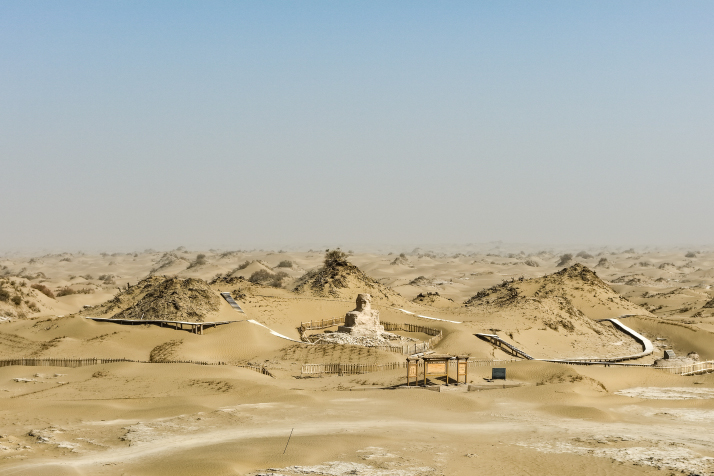 The Niya Ruins in Minfeng County, Hetian (Hotan) Prefecture, on October 17, 2025 (XINHUA)
Deep in the Taklimakan Desert in Xinjiang, the Niya Ruins in Minfeng County, Hetian (Hotan) Prefecture, were once the site of a mysterious realm known as Jingjue Kingdom, one of the 36 states of the Western Regions during the Han Dynasty (206 B.C.-A.D. 220). Its sudden disappearance is one of the most intriguing puzzles in the archaeological history of the Western Regions. The earliest historical record of Jingjue appeared in the Book of Han, the official chronicle of the Western Han Dynasty from 206 B.C. to A.D. 23. In the book, it is briefly mentioned as a small oasis city-state. The chapter Account of the Western Regions States records that "the Jingjue Kingdom, with its capital at Jingjue City, lay 8,820 li (about 3,700 km today) away from the national capital of Chang'an (now Xi'an in Shaanxi Province). It had 480 households, a population of 3,360 and 500 able-bodied soldiers. It had a commandant, left and right generals, and one postal station chief. To the north, it was 2,723 li (about 1,130 km today) to the seat of the Western Regions Frontier Command established by the Western Han government in 60 B.C. (modern-day Luntai area in Xinjiang). To the south, it took a four-day journey to the state of Ronglu along an empty and desolate route. To the west, it was 460 li (about 190 km today) to the state of Yumi." It was not until the early 20th century that the British explorer Aurel Stein and others excavated wooden slips and sheepskin documents written in Kharosthi—a script used in Gandhara, an ancient region covering present-day northwest Pakistan and southeast Afghanistan—and Chinese at the Niya Ruins, and both mentioned "Jingjue." The kingdom had reemerged from the depths of history, and unraveling the mystery of its disappearance has since become a pursuit for many historians and archaeologists. Researchers have proposed three hypotheses regarding the disappearance of the ancient kingdom: ecological collapse, foreign invasion and regional power shifts. However, these explanations remain largely speculative, based on incomplete records and limited archaeological findings, lacking comprehensive and reliable evidence. Further archaeological research is needed. 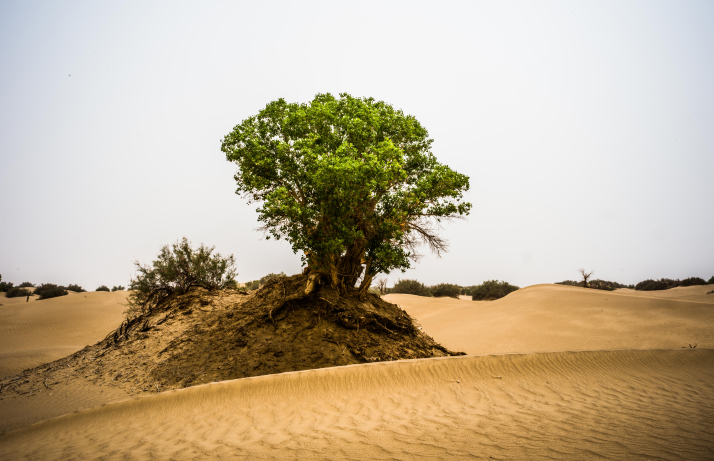 Desert poplars at the Niya Ruins in Minfeng County, Hetian (Hotan) Prefecture, on June 28, 2024 (VCG)
Ecological collapse This hypothesis stems from evidence that the water resources in the Niya area transitioned from abundant to depleted. The kingdom had been a thriving oasis, but it was also entirely dependent on the Niya River originated in the Kunlun Mountains. The waterway was a seasonal inland one that nourished this oasis, and without it, Jingjue would not have existed. Archaeological findings confirm that during the Qin and Han dynasties (221 B.C.-A.D. 220), the Niya River had abundant water that not only reached the Jingjue area but also sustained lush forests. The kingdom had a strict water management system, with designated "water officials" responsible for the unified allocation of resources. The main channels connecting villages had fixed release points; water could not be released outside scheduled times or without authorization. Jingjue also implemented forest protection regulations prohibiting the logging of live trees—"Cutting a live tree incurs a fine of one horse; cutting a branch incurs a fine of one cow." Nevertheless, these rigorous management and protection measures ultimately could not withstand the forces of natural change. The flow of the Niya River decreased year by year, leading to the collapse of the oasis ecosystem. Climate change may have caused the river to dry up or shrink, crippling the agricultural irrigation system on which Jingjue depended. Excavated Kharosthi documents explicitly mentioned that "Jingjue was in dire need of water" and described fields that could not be irrigated due to dry canals—a strong evidence for the ecological collapse hypothesis. From the perspective of historical and geographical change, the course of the Niya River has indeed undergone significant transformation over millennia. Archaeological findings showed that the alluvial fan of the ancient Niya River once spread out in a braided pattern and had a dense network of channels. Compared to the period of the Jingjue Kingdom, the present-day Niya River has retreated nearly 50 km southward. This geographical change clearly indicates that the water source on which the ancient kingdom depended for survival had been steadily diminishing. When the Niya River finally dried up, Jingjue lost the fundamental basis for life and agriculture—farming collapsed, fields could not be irrigated, residents could not cultivate crops, and food production ceased. The ecosystem disintegrated; poplar forests died off; birds and animals fled; the oasis gradually reverted to desert. Without water, the inhabitants could not survive and eventually deserted their dwellings. Thus, the trajectory of Jingjue was abruptly severed, leaving behind nothing but desolate, uninhabited ruins. The massive dead poplar trunks found at the Niya Ruins also confirm the region's transformation from a lush oasis of poplars and tamarisk into a barren wasteland. As the water sources that sustained this civilization vanished, the very foundation of Jingjue crumbled. 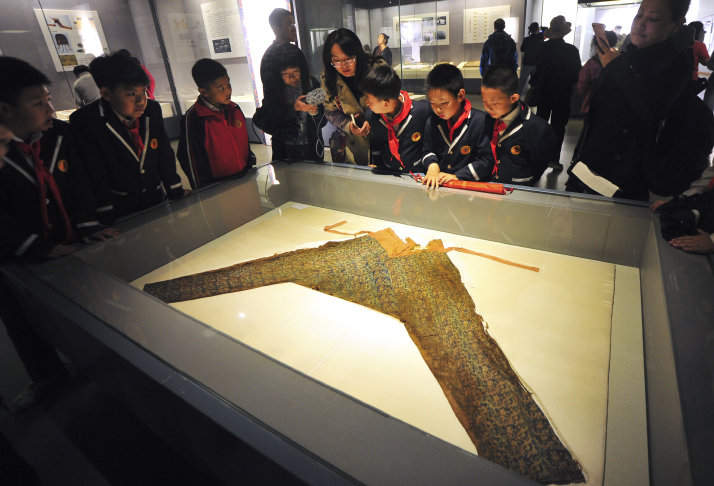 Visitors at an exhibition themed on the 30th anniversary of the joint expedition to the Niya Ruins by Chinese and Japanese archaeologists at the Xinjiang Museum in Urumqi on September 24, 2018 (XINHUA)
Foreign invasion Beyond natural factors, external military pressure might have been the final blow to Jingjue. Excavated Kharosthi wooden tablets repeatedly reveal that the kingdom was plagued by a hostile tribe from the southwest, known as the Supi. These documents indicated that Jingjue was in a perpetual state of military readiness, with the king deeply worried, describing the invaders as "savage, fierce and terrifying enemies, like demons." One letter stated, "Rumors here say that the Supi raiders will suddenly attack Qiemo in April. You should send mounted scouts here." Another document mentioned that "The enemy-controlled, treacherous paths encircle both cities—a mortal threat. The city on those paths must still be held." This leads to the conclusion that warfare had reached the kingdom's core defenses. The Supi were a branch of the Qiang people in the Western Regions. At their peak, their population may have reached tens of thousands, far outnumbering that of Jingjue. Given such a disparity in strength and continuous harassment, Jingjue's demise was almost inevitable. Stein's discoveries at the Niya Ruins paint a haunting picture: homes left with neatly stacked grain, unfinished textiles, and even the skeletal remains of dogs that had starved while still tethered to their posts. This suggests the people of Jingjue fled in sheer panic, abandoning even their most basic necessities. Such frozen-in-time scenes strongly echo the sudden devastation characteristic of warfare. When the Tang Dynasty (618-907) monk Xuanzang passed through Nirang City (the former land of Jingjue) on his return eastward, he described a terrifying scene of "scorching winds, haunting spirits and demons," stating that "directions were indistinguishable, water and grass were scarce, and one often heard singing, crying and howling; people were bewitched and lost." This desolate and enigmatic atmosphere may serve as a haunting reminder of the devastation caused by war and slaughter, preserved in local lore. Regional power shifts Another hypothesis is that Jingjue was annexed by the Shanshan Kingdom. Historical evidence for this appeared in the Book of the Later Han, which covered the history of the Eastern Han Dynasty (25-220). It states that Shanshan grew powerful during that period, and "the 13 kingdoms from Jingjue in the northwest to Shule all submitted." This indicates that Shanshan had the capacity to absorb smaller neighboring states like Jingjue. Jingjue's fate was closely tied to the rise and fall of the ruling dynasties in the Central Plains, the heartland of ancient China that covers the middle and lower reaches of the Yellow River, and regional powers in the Western Regions. The excavated Seal of the Agricultural Administration Office from the Han Dynasty confirmed that the central government stationed garrison troops and exercised effective administration there. However, in the late Eastern Han period, the Central Plains fell into prolonged division, creating a power vacuum in the Western Regions and leading to internecine strife. Without Han protection, Jingjue could hardly have survived independently for long in the predatory environment of Western Regions warfare. It was likely marginalized due to resource competition or diminished strategic value. The annexation of such a small state by a more powerful neighbor follows a well-established historical pattern. Thus, archaeologists speculate that Jingjue was absorbed by Shanshan, becoming a local administrative unit, and therefore disappeared from later historical records. Although Jingjue vanished, the extreme aridity of the desert burial environment at the Niya Ruins has preserved a large number of artifacts in excellent condition. They include buildings, wooden objects, silk, woolen textiles and mummies, all rarely seen in China or abroad. Stein recovered hundreds of Kharosthi wooden tablets from the Niya Ruins, which document vital elements of Jingjue's society, including the taxation system, laws, water management and military defense. These artifacts bring back into view this once-obscure ancient kingdom and provide invaluable material evidence for studying the history and culture of oasis city-states in the Western Regions during the Han and Jin (266-420) dynasties. The discovery and archaeological studies of Jingjue not only reveal the brief rise and fall of a small city-state in the Western Regions but also profoundly remind us that Xinjiang has been, since ancient times, a place of multiethnic coexistence and cultural convergence, maintaining close political, economic and cultural ties with the Central Plains. The disappearance of Jingjue is a typical microcosm of the extinction of a civilization node along the southern Silk Road. Today, only the excavated artifacts silently testify to the land's splendid history of cultural exchange, narrating in their unique way the grand story of Chinese civilization's integration, openness and inclusiveness. Comments to lanxinzhen@cicgamericas.com |
|
||||||||||||||||||||||||||||
|








