
|
| Xinjiang Today |
| Wings across the frontier | |
|
|
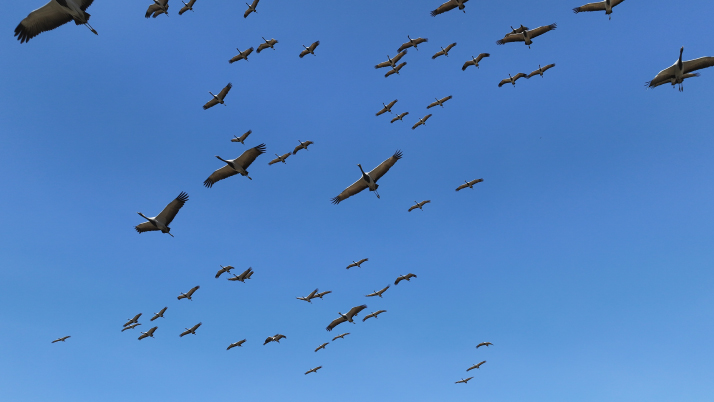 Demoiselle Cranes—a national second-class protected species—take to the skies in Hami on April 19 (VCG)
The Emin River in Tacheng Prefecture lay frozen amid a bitter wind in February 2008. Yiliyaer Yili, then head of public security in Tasierhai Village, was patrolling the riverbank when he spotted something he had never seen in winter before: two wild swans. He hurried back to the village for his camera, captured the rare sight, and watched the swans take flight. The next day, he returned with corn from his own farm, scattering it where the birds had rested. To his joy, the swans came back.
The two swans returned the following winter, and brought their young. Three became five, then 11, and then more. The swan family multiplied along the Emin River year by year. By the winter of 2024, 156 swans were wintering there. In 2025, that number rose to 186. The riverbank, once ordinary, became known as Swan Lake—a veritable paradise for migratory birds. And Yiliyaer, who started as a feeder, became a volunteer guardian, eventually inspiring fellow villagers to join the cause. Now prominent conservation notice‑boards have been installed along riverbanks to guide the public to watch birds politely and to join in conservation efforts. What began as one man's promise became a town's shared mission. 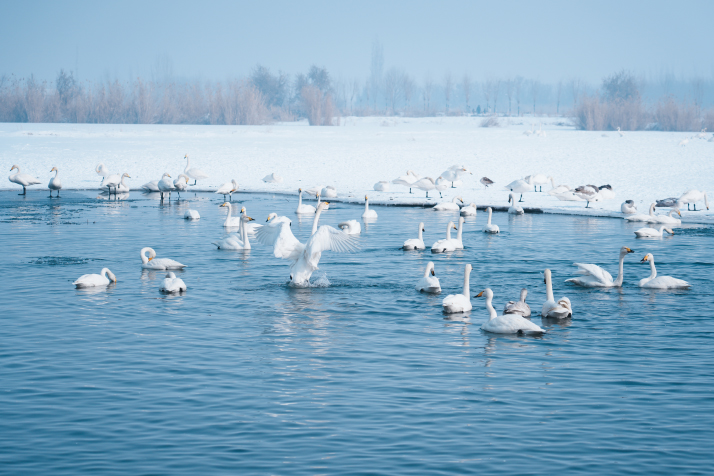 Flocks of swans glide and play on the winter wetland waters at Manas National Wetland Park in Changji Hui Autonomous Prefecture on February 18 (VCG)
Where three flyways converge What Yiliyaer protects reaches far beyond the swans of Emin River. Xinjiang stands as one of the most critical nodes in the global network of migratory bird routes, a fact increasingly recognized by ornithologists worldwide. According to Ma Ming, a researcher at the Xinjiang Institute of Ecology and Geography, the Chinese Academy of Sciences, Xinjiang is home to approximately 500 wild bird species, accounting for one third of China's total. At least 70 percent of these are migratory. The region's unique geography, bounded by the Tianshan Mountains and vast deserts, has long made its migration patterns a subject of scholarly debate. Early researchers proposed three possible routes: a north-south corridor to the Indian coast; a western path to southern Europe, the Mediterranean or Africa; and an eastern flyway toward Southeast Asia and Australia. Satellite tracking technology is now solving these mysteries. In the spring of 2025, a male European roller, identified by its tracker as Rory-284727, embarked from South Africa, flew up Africa's eastern coast, crossed the Strait of Hormuz, and passed through Iran, Afghanistan and Kazakhstan. After 68 days and more than 13,500 km, it arrived in north Xinjiang's Xiayedi. This small bird, carrying a tiny transmitter, provided definitive proof of the African-Xinjiang migration route. After a full summer in Xinjiang, it took off in September that year, heading south once more on its long migratory journey. The European roller is sensitive to habitat changes, making its population trends a crucial gauge of ecological wellbeing. "The steady numbers in north Xinjiang over recent years suggest rich food supplies and a healthy ecosystem," Ma said.  Residents watch migratory birds gliding on the water at a park in Urumqi on February 4 (VCG)
Volunteers to ecological policing Across Xinjiang's vast wilderness and wetlands, Yiliyaer is far from alone. In 2015, Chen Yuxiao, then 40, spotted a postcard at a market featuring a white-headed duck, a globally endangered species with a striking pale blue bill and pure white head. That single glimpse changed the course of her life. She learned that Bai Niao Lake (White Bird Lake) on the outskirts of Urumqi was home to more than 150 bird species, with the white-headed duck as its most precious resident. Chen joined the environmental group Wild Xinjiang and led volunteers to build 2.4 km of fencing around the lake and to set up a rudimentary patrol station. They cleared trash every weekend; fathers brought their young sons to help, passing on a love for nature. In 2016, with support from ornithologists at the Chinese Academy of Sciences, the Wild Xinjiang Bai Niao Lake Wetland Protection project was formally established, and the lake was designated China's only Chinese White-Headed Duck Conservation Area. Over the following decade, Chen participated in more than 2,600 conservation activities, including ecological outreach, public environmental education and anti-poaching patrols, logging over 13,100 volunteer hours. Her team expanded its efforts to protect Eurasian otters in Habahe County, training local herders to form volunteer patrols and developing eco-cultural tourism. "I genuinely love what I do," Chen said, "and I'm ready to act to inspire more people to care about protecting our environment and wildlife." In the spring of 2023, rangers at Manas National Wetland Park, one of China's most important wetlands, located in Changji Hui Autonomous Prefecture, made a surprising discovery: A pair of whooper swans had built a nest in the reeds instead of migrating north. That May, their first chick hatched—the park's first-ever recorded wild swan birth. That winter, the family stayed, becoming the wetland's first "year-round residents." They were named Suisui and Lailai, after "Suilai," the ancient name for Manas. The couple returned in 2024, raising one more chick. But 2025 brought a bigger surprise: six eggs, which all hatched into healthy cygnets on May 18. Each morning, Suisui patrols the waters before calling Lailai to lead the babies out; each evening, he gathers them under his wings. Why did they stay? Because the wetland became a true home. Over a decade of ecological restoration expanded the water area from approximately 2,700 to 4,700 hectares. Winter brings open water and daily corn feedings. By April, more than 10,000 migratory birds have already nested and laid eggs here. Suisui and Lailai are now local celebrities. Their story proves that with devoted care, even a stopover can become a forever home. Eyes in the sky Yiliyaer won the swans' trust with corn and cabbage. Chen guarded the white-headed ducks with fences and patrols. Others are using cutting-edge technology to unravel the mysteries of migration itself. Approximately 40 years ago, Xinjiang began using bird banding for migration research. Between 1997 and 1999, the China-United Arab Emirates joint project used satellite tracking for the first time to reveal the east-west migration route of the houbara bustard, a vulnerable bird species found in arid and semi-desert regions. In 2003, Ma and the Hong Kong Bird Watching Society conducted Xinjiang's largest banding operation to date, covering 17 sites and tagging 340 birds across 53 species. In recent years, satellite tracking has become increasingly sophisticated. The "backpack" on the European roller is a miniature transmitter that relays real-time location data. It was precisely this technology that allowed researchers to map that extraordinary 13,500-km journey spanning several countries. Encouragingly, monitoring data indicate that the European roller population in north Xinjiang stands at roughly 40,000 to 60,000 and shows a clear trend of eastward expansion, a testament to the health of the region's ecosystems. In early 2025, Xinjiang assembled six monitoring teams working alongside local technicians to conduct synchronized winter waterbird surveys across 44 monitoring units, 75 sub-zones and 179 observation points. Over an area of 67,000 hectares, they recorded 280,000 wintering waterbirds from 56 species, 12 families and seven orders, a staggering 115 percent increase over the previous year. Among them, the garganey made its first-ever appearance in Xinjiang. In the Manas National Wetland Park, the wintering population of whooper swans has reached 943, setting a new record high. Comments to luyan@cicgamericas.com |
|
||||||||||||||||||||||||||||
|