
|
| Xinjiang Today |
| Greening the Gobi | |
|
|
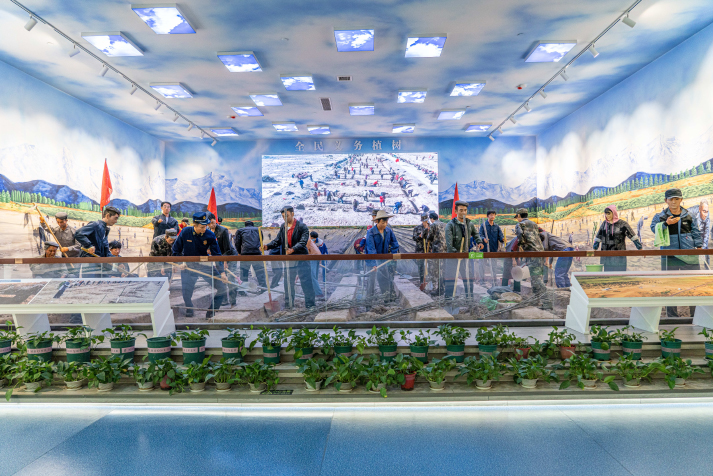 The Kekeya Memorial Hall recreates the massive tree-planting campaign launched in Kekeya in 1986 (VCG)
At the northwestern edge of the Taklimakan Desert, the largest desert in China and the second largest shifting desert in the world, lies a stretch of land once battered by wind and sand, now draped in green.
This is Kekeya in Aksu Prefecture. Forty years ago, it was nothing but a barren expanse of Gobi wasteland. Sandstorms swept across the terrain, threatening nearby settlements and farmland. Through the perseverance of several generations, a vast green belt has gradually unfolded there. Amid this sea of forest stand two trees known to local people as "Love" and "Hope." What makes them special is not their species, but a story that began four decades ago. The clock turns back to 1986. Zhao Tuanwa was on military service in Aksu. Just before he was due to return to his home province of Shaanxi to marry Yang Xiaoyan, he learned that his unit would join a large-scale desert greening campaign in Kekeya. Zhao wrote to his expectant bride, telling her he would stay on the Gobi front line to plant trees and fight desertification—and proposing to postpone the wedding. Far away from Kekeya, Yang waited anxiously for Zhao's return. "Could he have fallen for someone else?" Carrying her doubts, she boarded a train heading west. When Zhao brought Yang to Kekeya and she saw the desertification control work underway—people toiling under the scorching sun, planting trees across the barren ground—her eyes filled with tears. She told Zhao that she wanted to stay and plant trees alongside him. Witnessed by Zhao's fellow soldiers, the couple tied the knot right there at the afforestation site. After the ceremony, they planted a tree together. People later called it "Love." A decade later, Zhao, who had already left the military, and Yang returned to Kekeya with their child. The once desolate land had been transformed into a landscape of green. Together, the family planted another tree and named it "Hope." From a single sapling to a vast forest, from a wedding ceremony in the Gobi Desert to a lifelong commitment, the two trees carry the choices and dedication of an ordinary family. More than that, they mark the beginning of Kekeya's decades-long journey to hold back the desert. 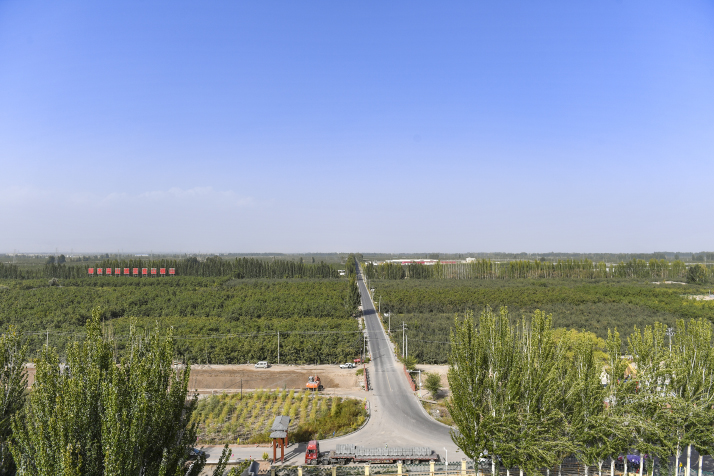 Shelter forests in Kekeya, Aksu Prefecture (VCG)
A miracle of life Faced with destructive sandstorms and a fragile ecological environment, Aksu launched the Kekeya Desertification Control Project in 1986 after extensive surveys and careful assessments. The first challenge was water. The Gobi Desert had long endured severe drought and lacked reliable natural water sources. To make large-scale afforestation possible, workers first had to build an irrigation system capable of bringing water into the barren land. In April 1986, a team of more than 250 workers headed to Kekeya to dig canals. After four months of relentless labor under harsh conditions, they completed a 16.8-km anti-seepage canal, along with 505 supporting structures including bridges, culverts and water gates. The canal became a lifeline, bringing stable water supplies into the desert. The second challenge was the land itself. The soil in Kekeya had been hardened by millennia of sediment accumulation and salinization. Under the project plan, workers had to level nearly 135 hectares of barren land within one month. The task fell to project leader Li Zhongkang. The ground was so hard that pickaxes sparked against the surface and bulldozers could barely leave a mark. After repeated trials, Li and his team devised a practical approach: soaking the saline soil with water to soften it, then using machinery to strip away the loosened earth layer by layer. Through this combination of persistence and innovation, the seemingly impossible task was eventually accomplished. The third challenge was keeping the trees alive. Bi Kexian, then Director of the Aksu Prefectural Forestry Department, led a team of forestry technicians through years of soil improvement experiments. By analyzing soil samples and testing different restoration methods, they gradually brought the soil's salt content down from an inhospitable level to 0.8 percent, creating the conditions necessary for afforestation. Years of working directly with the earth left a lasting mark on Bi. To assess soil moisture, salinity and fertility, he often tested the ground with his bare hands. Decades of such labor made the thumb, index finger and middle finger of his right hand thicker and rougher than those of his left, with hardened, deformed nails resembling a small iron farming tool—a quiet testament to his dedication to restoring the desert. Generation after generation of desert fighters devoted themselves to the land, allowing Kekeya's green cover to gradually expand outward, reclaiming areas once dominated by barren Gobi. During the first decade of the project, 2,200 hectares of artificial afforestation were completed. In the following decade, the green area grew further, with an additional 4,360 hectares of forests planted. To date, 54 large-scale tree-planting campaigns have been carried out in the Kekeya area, drawing 3.9 million participants. Along the edge of the desert, a "green belt" stretching approximately 50 km in length and 47 km in width has emerged, forming a vital ecological barrier against sandstorms. This transformation has changed more than just the color of the land. It has also reshaped the relationship between people and nature. Building on the Kekeya project, Aksu has continuously advanced ecological restoration efforts, prioritizing the integrated protection and restoration of mountains, rivers, forests, farmland, lakes, grasslands and deserts. Over the past four decades, the prefecture has carried out afforestation across more than 390,000 hectares and more than 560,000 hectares of desertified land have been reclaimed. The local forest coverage rate has increased to 9 percent. Meanwhile, wetland areas have expanded to more than 150,000 hectares and biodiversity has gradually recovered. Aksu is now home to more than 270 species of wild animals and over 520 species of wild plants. 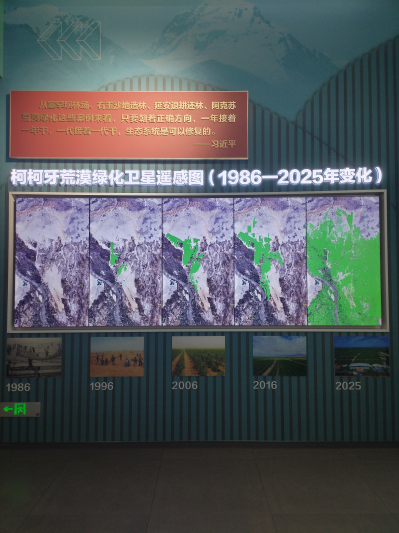 Satellite images showing the transformation of Kekeya from 1986 to 2025 (XIANG YUTING)
New growth drivers Desertification control is not merely about planting trees to hold back the sands. More importantly, it is about letting greenery truly transform people's lives. As the ecological environment improves, Aksu has explored a path where environmental protection and economic development reinforce each other. Trees that once served only as a shield against wind and sand have now become new sources of income for local communities. Among these achievements, the development of a specialty fruit industry stands out as one of the most striking examples. After years of development, Aksu now has orchards covering 300,000 hectares, constituting what locals call a "sweet industry." Specialty products such as apples, thin-shelled walnuts and dried apricots have developed into large-scale industries, with annual output exceeding 3 million tons, the highest in Xinjiang. Official data show that fruit production accounts for nearly 30 percent of the per-capita disposable income of local farmers. For many farming households, fruit trees have enabled a transition from "protecting greenery" to "harvesting the benefits of greenery." To generate greater value from these fruits, Aksu has continued to extend the industrial chain, expanding from cultivation into processing and brand marketing. The prefecture has established 12 agricultural product deep-processing parks, with an annual capacity of 1.67 million tons for forest and fruit products. Meanwhile, the digital technology is injecting new vitality into the traditional fruit industry. In the past, hampered by inadequate transportation infrastructure and limited sales channels, many high-quality fruits from Aksu and other parts of south Xinjiang struggled to reach wider markets. Today, the rise of e-commerce is changing that. A growing number of young people have returned to their hometowns to start businesses, leveraging livestreaming and online promotion to connect local products with consumers across China. Li Bo, President of the Aksu E-commerce Association, is one such entrepreneur, driven by the desire to help quality products from his hometown reach more consumers. In the past, "even the best fruits had difficulty making their way out of south Xinjiang," he said. In his view, e-commerce has not only expanded sales channels but also accelerated local industrial upgrading. Feedback from consumers has encouraged growers to pay greater attention to standardized production and branding, helping fruit farmers adapt to the digital economy. The benefits brought by ecological improvement have also extended into tourism. In recent years, Aksu has made full use of its ecological and cultural resources to develop eco-tourism, rural tourism and other new initiatives. Its annual revenue from sightseeing services has exceeded 22.1 billion yuan ($3 billion). At the same time, ecological restoration has created employment opportunities. Nearly 3,700 positions in environmental conservation have enabled local residents to participate in the effort while increasing their incomes. At a press conference marking the 40th anniversary of the Kekeya project, held on July 16, Ayixianmuguli Atawulla, Director of the Aksu Prefectural Forestry and Grassland Bureau, said the prefecture has actively embraced the concept that "lucid waters and lush mountains are invaluable assets," promoting a transition from simply protecting greenery to achieving common prosperity through ecological development. 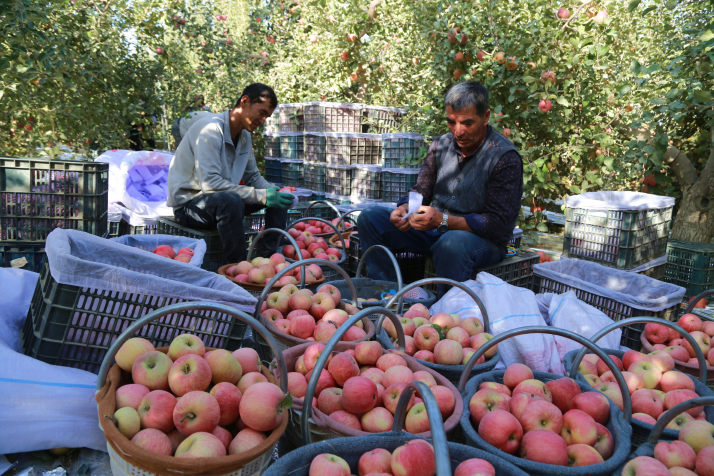 Farmers harvest apples in an orchard in Awati (Awat) County, Aksu, in October 2025 (VCG)
Seeds of spirit At an exhibition celebrating the 70th founding anniversary of Xinjiang Uygur Autonomous Region in September 2025, a collection of striking satellite images vividly capture the dramatic transformation of Kekeya over nearly four decades. The 1986 photographs show a landscape deeply scarred by erosion, with gullies cutting through the alluvial plain. Thick layers of saline soil blanketed the surface, revealing a barren desert terrain. By contrast, pictures from 2025 present a completely different scene. At the foot of the Tianshan Mountains, the land once ravaged by wind and sand had been transformed into a green expanse of fields. These images, spanning four decades, record more than ecological improvement. They also bear witness to the spirit of generations of desert fighters—self-reliance, unity, perseverance, hard work and dedication. Known as the "Kekeya Spirit," this legacy has grown alongside every sapling planted in the desert and has been carried forward through generations of sustained efforts. Yimamu Maimaiti was the first director of the Kekeya Three-North Shelterbelt Forest Management Station and one of the earliest participants in the desertification control project. During the early stages, he led his team in planting trees despite sandstorms, saline soil and water shortages. Aisikaer Yimamu is Yimamu's son. Inspired by his father, he joined tree planting activities in Kekeya while still in middle school. Later, he chose a career in forestry and grassland management, taking over his father's "green relay baton." "To improve the ecological environment, afforestation requires the dedication of successive generations," Aisikaer, now a senior technician at the Forestry Development Service Center of the Aksu Prefectural Forestry and Grassland Bureau, said. This green legacy is far from an isolated family story; it has become a shared tradition across Aksu. Aynigul Eymail, Deputy Director of the Kekeya Memorial Hall, is one of the many who carry on this mission. Her grandfather once planted trees in Kekeya with a shovel. Her father later took up the mantle of ecological conservation, and today she shares with visitors the story of how the desert was transformed. For her, tree planting has become a shared memory among local residents. "Every year, I take my children to plant several trees as well. In Aksu, it is difficult to find an adult who has never participated in voluntary tree planting. It is a common experience shared by everyone living on this land," she said. Today, the Kekeya story continues to spread farther. Building on the experience of the Kekeya project, Aksu has launched a series of large-scale ecological restoration projects since 2015, including those in the Aksu River Basin, the Weigan River Basin, Kongtailike and Aishiman. Covering more than 260,000 hectares in total, they have expanded greening efforts from individual sites to broader watershed-based management. Located about 80 km southwest of Kekeya, Aishiman in Awati (Awat) County was once the last major source of sandstorms within the Aksu oasis. In 2021, the Aishiman Ecological Restoration and Desertification Control Project kicked off. To date, ecological restoration across more than 52,560 hectares of land has been completed. Through coordinated efforts, vegetation coverage has increased from 4.5 percent to 45 percent, while wetlands have expanded and biodiversity has notably improved. From Kekeya to Aishiman, from a single tree to a vast forest, from the perseverance of one generation to the relay of many more, the story of green transformation continues along the edge of the Taklimakan Desert. Comments to xiangyuting@cicgamericas.com |
|
||||||||||||||||||||||||||||
|








