
|
| Xinjiang Today |
| Putting down roots in the desert | |
|
|
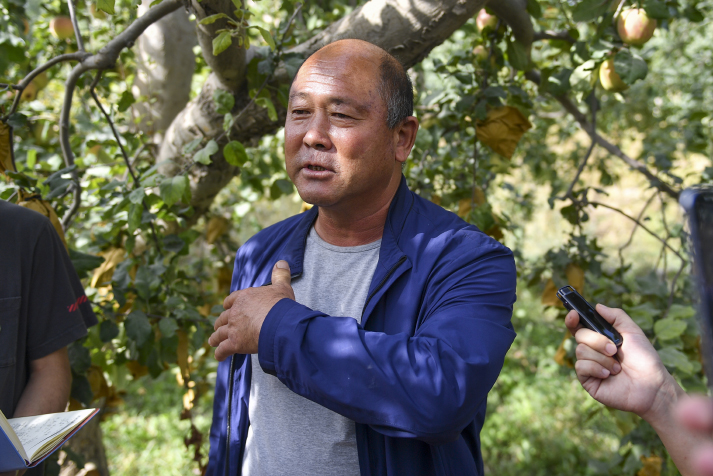 Song Jianjiang is interviewed in Kekeya, Aksu, on September 23, 2021 (VCG)
On July 15, at the Kekeya Memorial Hall in Kekeya Town, Aksu Prefecture, 62-year-old Song Jianjiang bent down to gently touch a rusty kantuman, the most popular iron farm tool among Xinjiang's Uygur people used for plowing, digging irrigation channels and weeding.
As a first-generation Kekeya forester, Song has spent over 30 years planting trees in the Kekeya area, witnessing the miracle of this barren Gobi Desert transforming into tens of thousands of hectares of lush forests. This kantuman accompanied him as he dug countless tree pits and built dozens of kilometers of irrigation canals. This year marks the 40th anniversary of the launch of the Kekeya greening project. Four decades ago, this place was choked by flying yellow sands. Today, a "green wall" that is 50 km in length and 47 km in width stands like a bulwark along the northern edge of the Taklimakan Desert. 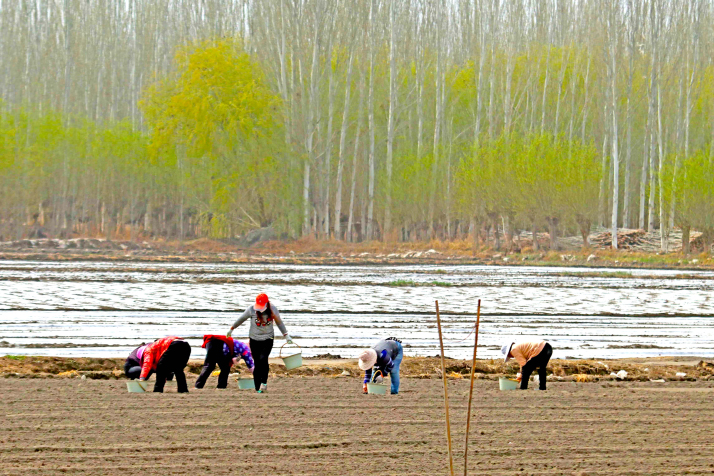 Farmers work at an almond nursery in Wensu County in April 2021 (VCG)
Chasing a dream In the spring of 1987, Aksu drew foresters from several counties to support the newly launched Kekeya greening project. A then 23-year-old Song was a worker at a forest farm in Wensu County of Aksu. He had a stable job and life, but the perennial yellow sand outside his window left him restless. "Kekeya is the main battlefield for sand control in Aksu," he told newspaper Xinjiang Daily. "Only by going to a place like this could I truly accomplish something." When he shared this idea with his father, he met immediate resistance. In his father's eyes, his son had never ventured out on his own, and Kekeya was a desolate wasteland of salt flats and howling winds without even decent housing. However, Song did not compromise. After numerous earnest talks, his father finally asked, "Are you really going?" "I'm determined to go. No matter how harsh the Gobi environment is, I need to go out and temper myself." His father slowly nodded. On March 17 of that year, right after lunch, Song packed his bags and headed for Kekeya. Turning back to wave goodbye, he caught his father wiping away tears. Unable to bear saying anything more, Song stepped on the tractor accelerator and drove toward Kekeya. Poplar trees on both sides of the road flashed past. The future was unknown, but Song's heart was filled with longing. Yet, life in Kekeya proved even harsher than he had imagined. There were no houses. They dug pits, laid down a few wooden beams and covered them with grass mats to create diwozi ("makeshift caves"). More than a dozen people squeezed into each one, so tight they could barely turn over. There was no clean water; they drank muddy water thick with silt. Meals were even simpler: dry naan bread eaten with salted vegetables. When they were too busy to stop, they would just gnaw on a piece of hard naan in the fields. Yet no one complained. Every day before dawn, brothers of all ethnic groups, Han, Uygur and Kazak, slung their kantuman over their shoulders and headed out. The saline-alkali soil was as hard as stone. A strike with a kantuman left only a white scratch. When the skin between their thumbs and forefingers cracked from the vibration, they simply wrapped a piece of cloth around their hands and kept working. The biggest challenge was water. Without water, newly planted trees would not survive. Water was channeled from major canals several km away. Once the water arrived, someone had to guard it day and night; a single leak or misdirected flow would doom the saplings. Song and his coworkers took turns on night patrols, armed with only a flashlight for illumination. The Gobi nights were bone chilling, with cold piercing straight through thick cotton coats. When sleepiness overtook them, they would catch a brief nap right by the canal before getting back to work. "Back then, there was only one thing on our mind: As long as the trees could live, nothing else mattered," Song said. Years of gripping a kantuman left Song's palms thick with calluses, his fingers scarred but sturdy.  The Kekeya Memorial Hall in Wensu County, Aksu Prefecture, on September 23, 2021 (VCG)
From manual labor to smart governance Today, the retired Song has settled near Kekeya. This land, to which he contributed his youth, is his favorite place to visit in his spare time. Sometimes, he walked into the memorial hall to pick up that old kantuman and tell tourists stories of the old Gobi days; other times he strolled through the forests with his wife, gazing at the rolling shelterbelts and vast orchards, and looking down at the crisscrossing irrigation canals beneath their feet. Whenever he stands amid the sea of green, Song is filled with deep emotion. He is proud to be one of the countless young farm workers who rushed to the barren sands with burning passion more than 30 years ago and forged this green wall along the northern edge of the Taklimakan Desert. Stepping out of the memorial hall, not far away in a forestry and fruit base, young forestry technicians were operating drones to spray liquid nutrients, while managing the entire forest's automated drip irrigation system with a single tap on a smartphone app. Further away, at the frontlines of the broader battle to contain the fringes of the Taklimakan Desert, intelligent tree-planting robots shuttle across the sand sea, precisely handling entire processes like pit-digging and sapling planting. More than three decades ago, such scenes were beyond Song's wildest imagination. Back then, people of all ethnic groups relied on physical labor to dig canals and wash away alkaline salts, guarding saplings day and night. Today, technology empowers ecological management, boosting efficiency dramatically and the younger generations are writing a new green chapter. The actual numbers speak volumes about the transformation: The per-capita annual income of farmers in the Kekeya region increased from 300 yuan ($44) 40 years ago to 26,000 yuan ($3,842) today. "Our generation suffered the worst of the Gobi's hardships so that our future generations could live happier lives," Song said. The Kekeya Spirit Inside the Kekeya Memorial Hall, that rusty kantuman sits quietly. Song has raised it countless times to recount the reclamation years of the 1980s to young people. Looking out the window at the boundless sea of green, young visitors are invariably awed. Ayinigeer Aimaier, a guide at the memorial hall, told Xinjiang Daily that after hearing Song's stories, many students take the initiative to participate in voluntary tree-planting. The Kekeya Spirit, characterized by "self-reliance, unity, perseverance, hard work and dedication," has never faded. The Kekeya greening project is no longer just a single afforestation project across the Aksu Prefecture; it has become a model guiding Aksu's other ecological projects. Hundreds of species of wild flora and fauna now inhabit and reproduce here. The "Kekeya experience" of arid zone ecological governance has spread beyond Xinjiang, providing a valuable blueprint for global desertification control. Comments to jijing@cicgamericas.com |
|
||||||||||||||||||||||||||||
|








