
|
| Xinjiang Today |
| Clean power, reimagined | |
|
|
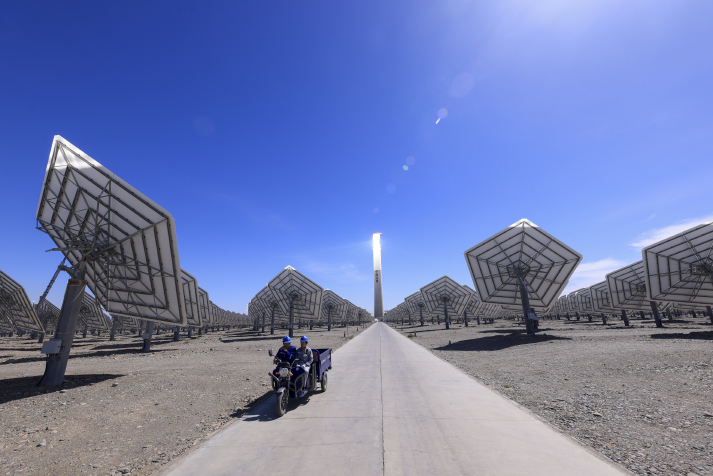 Engineering staff conduct equipment inspections at a project combining solar thermal and photovoltaic power generation in Hami City on May 28 (VCG)
During the height of summer, a vibrant picture of industry turning "new and green" is unfolding across the Tianshan Mountains. From photovoltaic (PV) arrays sprawling across the edges of the Taklimakan Desert to wind turbine forests blanketing the Junggar Basin, and from zero-carbon petrochemical bases deep in the Gobi Desert to green computing hubs, Xinjiang is undergoing a profound transformation, encompassing both a comprehensive energy transition and a fundamental industrial paradigm shift.
The latest official statistics show that as of late February, Xinjiang's installed new-energy capacity exceeded 173 million kilowatts (kw), ranking among China's top provincial-level regions and accounting for over 60 percent of the region's total power capacity. The figure marks the maturing of a diversified, complementary green energy supply system across Xinjiang. More importantly, it demonstrates how the region is translating abundant wind and solar resources into tangible industrial competitiveness and new quality productive forces—a term denoting productivity driven by high-quality innovation, green transformation and advanced technologies. 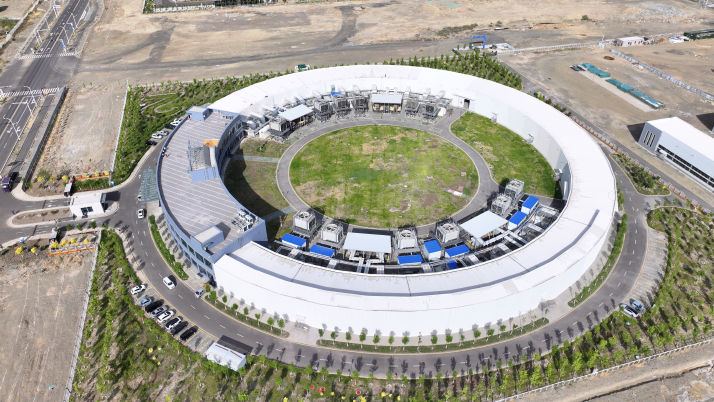 A carbon neutral liquid cooling data center in Kelamayi (Karamay) on May 8 (VCG)
Anchoring upgrading Xinjiang hosts some of China's richest wind and solar reserves. Yet converting intermittent renewable power into stable, low-cost industrial electricity remains a core challenge. Cutting-edge projects arising across the Gobi Desert are delivering practical solutions. In Balikun (Barkol) Kazak Autonomous County, Hami Prefecture, construction speeds ahead on the world's largest single concentrated solar power (CSP)-PV-storage integrated complex. Fitted with an eight-hour high-temperature molten salt thermal storage system, the facility stores surplus thermal energy collected during daytime to sustain steady power output at night and on cloudy days, effectively tackling the volatility of renewable energy. "It converts the intermittency of PV power generation into stable, dispatchable green electricity," Zhang Wei, Deputy General Manager of Xinjiang Energy Development Co. Ltd. under the China Energy Construction Group, told newspaper Enterprise Observer. Meanwhile, Ruoqiang County in Bayingol (Bayingolin) Mongolian Autonomous Prefecture is home to China's largest desert-based PV project with the highest single-site installed capacity in the country's sandy, rocky and desert areas. The project is not merely an energy base, but also a testing ground for the integration of ecology and technology, Guo Xiaoyang, head of the project, told Xinhua News Agency. According to him, upon achieving full commercial operation on May 29, 2025, the facility generates 6.9 billion kilowatt-hours (kwh) of electricity annually—enough to power 2 million households. "Beyond creating over 10,000 job opportunities, we have pioneered an innovative ecological model of generating power above while restoring the land below, bringing new life to the Gobi Desert," he added. The mechanism of direct green power supply has become a powerful magnet drawing energy-intensive and hi-tech industries. In Emin County, Tacheng Prefecture, Mayitasi (Maytas), a region widely known for its harsh weather conditions, boasts annual effective wind utilization hours between 2,800 and 3,200. Local authorities are planning a supporting 2-million-kw wind farm that will deliver low-cost renewable power directly to industrial parks via dedicated power grids. Driven by reliable green electricity supply, an aluminum electrolytic capacitor foil project worth approximately 1 billion yuan ($147 million) has quickly moved into production. More notably, it has catalyzed a broader new materials industrial park with total investment of 12.67 billion yuan ($1.88 billion), projected to yield an annual output value of more than 45 billion yuan ($6.7 billion), Ning Xumeng, Deputy Director of the Project Service Center under the Development and Reform Commission of Emin County, told newspaper China Daily. The push for green power access aligns with Xinjiang's broader efforts to refine its investment landscape. The region is strictly curbing the unbridled expansion of energy- and emission-intensive projects, while mandating rigorous energy conservation reviews and carbon assessments for new fixed assets investments. To date, Xinjiang has built a robust green manufacturing system encompassing 120 green factories, nine green industrial parks and seven green supply chain enterprises at the national level. Green electricity also underpins steady growth in Xinjiang's outbound power transmission. In 2025, the region transmitted 141.299 billion kwh of locally generated electricity to other parts of the country, surpassing 100 billion kwh for six consecutive years—including 44.382 billion kwh from renewable sources. This green outflow satisfies demand in recipient regions while creating a solid low-carbon foundation for local industrial development. 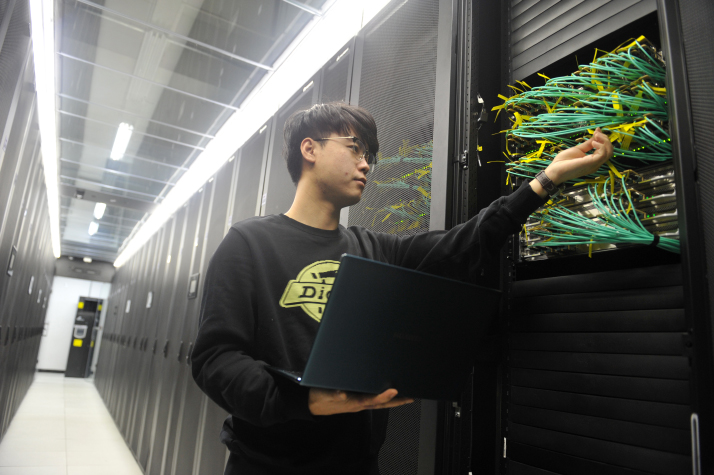 An engineer works at a cloud computing center in Urumqi on February 13, 2025 (VCG)
Industrial metamorphosis For decades, coal-laden trains heading east defined Xinjiang's role as an energy supplier. Today, leveraging its green power advantages, the region is transforming from an energy transit corridor into a digital economy hub—turning electricity into computing power. In Yiwu County, Hami, once-barren Gobi terrain now hosts a computing innovation demonstration zone. The zone achieves 100-percent direct green power connectivity and has attracted 19 computing enterprises. For example, Hami and Chongqing Municipality are over 2,000 km apart, a vast distance in physical space—it takes about three and a half hours by air or around 30 hours by train. Yet in the digital realm, a computing data packet can make the roundtrip in just 32 milliseconds. Wang Hailin, Deputy Director of the Digital Development Bureau of Yiwu, said local computing resources mainly serve the Beijing-Tianjin-Hebei region, the Yangtze River Delta, Sichuan Province and Chongqing, and are widely applied in key sectors including financial services, AI model training and intelligent connected vehicles. "At present, our core task is to continue expanding computing power to achieve industrial agglomeration effects. By the end of this year, the total computing capacity brought online across the county is expected to exceed 40,000 petaflops," he said in June. This green power plus computing model embodies Xinjiang's implementation of China's mega data project dubbed "Eastern Data, Western Computing," which was launched in 2022 and aims to channel more computing resources from the country's eastern areas to its less developed western regions. In the first quarter of 2026, new-energy generation accounted for 118 percent of the growth in Xinjiang's total electricity consumption, meaning clean energy covered all additional power demand while output from conventional power sources declined slightly. The decarbonization of established heavy industries is equally transformative. In July, PetroChina Dushanzi Petrochemical's Tarim 1.2-million-ton ethylene project entered operation in Kuerle (Korla), Bayingol. It stands as the world's first demonstration base for carbon recycling from ethylene cracking furnaces. By breaking through technical bottlenecks for large-scale utilization of ultra-low-concentration carbon dioxide, the project can achieve annual carbon reductions of 1.37 million tons. The light industry is also pursuing greener trajectories. Cotton textile manufacturers in Aksu and Bayingol have widely adopted intelligent, water-recycling production workflows. Xinjiang Lihua Textile, a national-level green factory, recycles wastewater and safely disposes of solid waste. Building on premium local cotton resources, it produces low-carbon textiles, supporting income growth for local residents. Developing green computing and low-carbon manufacturing based on renewable strengths "enables Xinjiang to compete on an equal footing nationwide and seize emerging industrial tracks of the future," Qiao Gang, President of the Xinjiang Academy of Science and Technology for Development, told newspaper Xinjiang Daily. Long-term vision The pivot toward innovative, eco-friendly investment is underpinned by coordinated progress in policy, capital and markets. In March, 18 centrally administered state-owned enterprises signed 92 project cooperation agreements with Xinjiang, pledging a total investment of approximately 170 billion yuan ($25 billion). Notably, computing industries and high-end equipment manufacturing were included in this framework on a massive scale for the first time, marking a clear shift in local investment toward integrated industrial chains spanning green power, computing and advanced manufacturing. Specialized financing platforms are fueling industrial growth. Launched in Shihezi in 2023 with an initial capital of 2 billion yuan ($294 million), the Oasis Silk Road Fund is setting up multiple dedicated sub-funds targeting new-energy and digital sectors. This initiative is designed to build a full-lifecycle "patient capital" ecosystem for local enterprises. However, Xinjiang's leap from an energy heartland to a computing powerhouse is not without real-world challenges. Computing infrastructure demands heavy investment with long payback periods, cross-regional scheduling requires more robust network support and a shortage of specialized professionals remains a bottleneck that must be addressed through sustained efforts. In response, Xinjiang is doubling down on improving business environment, streamlining administrative procedures and promoting AI-powered government services. The region's computing ambitions extend well beyond China's borders. From co-establishing joint laboratories with Central Asian countries to providing satellite remote sensing and smart agriculture services, and from safeguarding cross-border energy pipelines to enabling digital governance, Xinjiang's green computing power is emerging as a new engine for high-quality cooperation under the China-proposed Belt and Road Initiative, which aims to boost connectivity along and beyond the ancient Silk Road routes. By translating its energy advantages into a competitive edge in the digital economy, Xinjiang's green industrial transformation is only just beginning. Comments to mamm@cicgamericas.com |
|
||||||||||||||||||||||||||||
|