
|
| Xinjiang Today |
| Codified equality | |
|
|
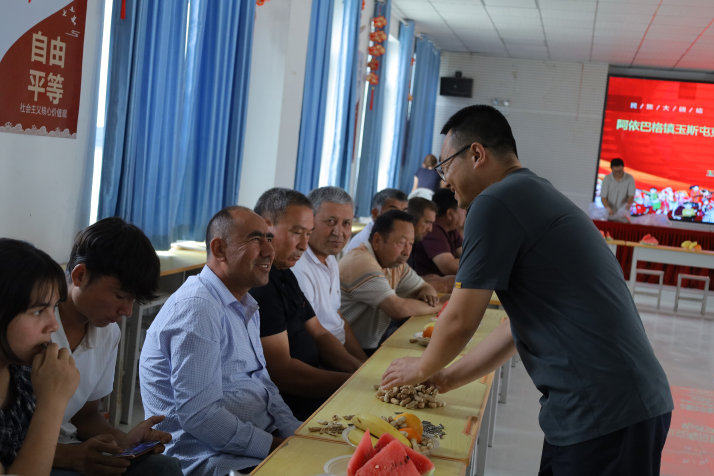 Villagers gather for a party in celebration of the Corban Festival in Awati (Awat) County, Aksu Prefecture, on May 25. The Corban Festival, also known as Eid al-Adha or the Festival of Sacrifice, is a public holiday in Xinjiang (VCG)
When the Ethnic Unity and Progress Promotion Law took effect on July 1, it was the culmination of a legislative process that began decades ago. The Xinjiang Center for Human Rights Studies at the Xinjiang Academy of Social Sciences released a detailed assessment on July 21, concluding that the law "systematically integrates the norms for protecting the equal rights of ethnic minorities scattered across Chinese laws and administrative regulations."
This framing captures the law's essential character. It consolidates protection provisions previously scattered across the Constitution, the Law on Regional Ethnic Autonomy, the Criminal Code, and dozens of administrative regulations. That consolidation is its primary contribution to China's legal architecture for minority rights. Before this law was introduced, a citizen seeking to understand their rights might need to consult multiple documents released over seven decades. The new law removes that necessity. It brings together protections covering economic, social, cultural, civil, political and environmental rights under a single framework. The assessment report calls it "the most systematic, complete legal provision for the protection of the rights of ethnic minorities in China." The existing legal framework was already extensive. The Constitution of China mandates that "the state helps all ethnic minority areas accelerate their economic and cultural development according to the characteristics and needs of the various ethnic minorities." Article 118 of the Constitution grants autonomous institutions the authority to "independently arrange and manage local economic development," while Article 122 requires the state to provide financial, material and technical assistance to ethnic minorities. The Law on Regional Ethnic Autonomy goes further, requiring in Article 55 that higher-level state institutions "help and guide ethnic autonomous areas in the study, formulation, and implementation of economic development strategies" and "formulate preferential policies to guide and encourage domestic and foreign investment in ethnic autonomous areas." These provisions already existed. The new law consolidates and elevates them.  Residents make zongzi together in an Urumqi neighborhood on June 16. Zongzi are sticky rice dumplings wrapped in bamboo or reed leaves, traditionally consumed during the Dragon Boat Festival, which fell on June 19 this year (VCG)
On economic rights, Articles 34 through 39 of the new law are specific. The state must improve infrastructure, including transportation, energy, water, information and logistics, in order to close the gap in living standards between ethnic regions and other parts of the country. It must also support local industries such as agriculture and cultural tourism. Article 36 requires the state to support ethnic regions in "developing agriculture, forestry, animal husbandry, fishery, food processing, textiles and cultural tourism, as well as traditional crafts, traditional medicine, and other characteristic and advantageous industries." Article 34 requires the state to support ethnic regions in integrating into the Belt and Road Initiative framework and serving the new development paradigm. The Belt and Road Initiative, proposed by China in 2013, aims to enhance connectivity along the ancient Silk Road trade routes and beyond for common development and prosperity. On cultural rights, Article 15 requires the state to "respect and protect the learning and use of the spoken and written languages of ethnic minorities" and to "promote their standardization and development via information technology." The Constitution already guarantees that "all ethnic groups have the freedom to use and develop their own spoken and written languages." The regulations released by the State Council for the implementation of the Law on Regional Ethnic Autonomy required the state to support the standardization and popularization of the spoken and written languages of ethnic minorities." What the new law does is bringing all of these guarantees under one roof. Article 29 further encourages "mutual appreciation of excellent traditional cultures and mutual learning of languages." For minority communities concerned about language preservation, these provisions offer specific, consolidated guarantees. On social rights, Articles 22 through 26 address housing, employment, education and healthcare. Local governments must adopt measures to promote ethnic integration in urban planning, population management and social services. Inter-regional university enrollment and teacher exchanges are explicitly encouraged. Article 37 requires the rational allocation of public service resources in employment, education and healthcare to "enhance the balance and accessibility of basic public services." Article 25 requires governments to "protect the legitimate rights and interests of citizens who move across regions for employment and entrepreneurship." Article 23 requires local governments to "organize and guide people of all ethnic groups to participate together in community development, community governance and community activities." These provisions address the difficulties of minority citizens in an increasingly mobile society. Political representation is reinforced through Article 49, which requires strengthening ethnic region cadre teams and "attaching importance to the cultivation and use of ethnic minority cadres." The Constitution already ensures that "all ethnic minorities should have appropriate numbers of deputies" in the National People's Congress. The Law on Regional Ethnic Autonomy already mandates that the chairperson of an autonomous region must be "a member of the ethnic group exercising regional autonomy." The new law makes these principles more explicit at a higher legislative level. Article 8 of the law states that "the state persists in and improves the system of regional ethnic autonomy, safeguarding national unity and ethnic unity." This reaffirms that minority political participation operates within China's unified framework rather than through separate political structures. Civil rights protections are reinforced through multiple provisions. Article 5 states that "all ethnic groups are equal before the law" and "discrimination and oppression against any ethnic group are prohibited." Article 9 requires that "the state governs ethnic affairs in accordance with the law, protects the legitimate rights and interests of all ethnic groups, and strengthens the promotion of and education on the Constitution and laws." Article 31 prohibits any organization or individual from producing or disseminating information containing ethnic hatred or ethnic discrimination. The Criminal Code already punished those who publish content that discriminates against or insults ethnic minorities, but the new law centralizes these civil rights protections. One provision deserves particular attention. Article 38 requires optimizing agricultural, ecological and urban spatial layouts while strengthening ecological environmental protection and sustainable natural resource use in ethnic regions. Article 66 of the Law on Regional Ethnic Autonomy already requires that "any organization or individual that develops resources or constructs projects in ethnic autonomous areas must take effective measures to protect and improve the local living environment and ecological environment, and prevent pollution and other public hazards." The new law elevates this protection. Article 4 of the law further emphasizes "jointly safeguarding the ecological homeland where humanity and nature coexist in harmony," embedding environmental rights within the broader framework of ethnic unity. The assessment found the law to be in alignment with international human rights instruments. It cites the International Covenant on Economic, Social and Cultural Rights, the UN Declaration on the Rights of Persons Belonging to National or Ethnic, Religious and Linguistic Minorities, the Vienna Declaration and Programme of Action, and the International Convention on the Elimination of All Forms of Racial Discrimination. The law's prohibition of discrimination based on ethnicity in employment and services corresponds to the International Convention on the Elimination of Racial Discrimination's Article 5. Its protection of marriage freedom regardless of ethnicity aligns with the Universal Declaration of Human Rights' Article 16. Its provisions on language rights match the UN Minorities Declaration's Article 2. The assessment's extensive citation of international instruments reflects a deliberate effort to ground the law in globally recognized standards. The assessment notes that the law's framework for environmental rights corresponds to Article 1, paragraph 2 of the International Covenant on Economic, Social and Cultural Rights, which states that "all peoples may, for their own ends, freely dispose of their natural wealth and resources." The difference lies in the framework. China's approach emphasizes integration within a unified national structure rather than a framework of group autonomy or separation. The law's preamble states that all ethnic groups together "opened up the vast territory of the motherland, jointly created a unified multi-ethnic country, jointly wrote the brilliant history of China, jointly created the splendid Chinese culture, and jointly cultivated the great national spirit." Article 6 states the state "persists in enhancing commonality while respecting and accommodating differences." This dual commitment to unity and diversity is the law's central philosophical claim. It distinguishes China's approach from both assimilationist models that erase difference and separatist models that fragment national unity. Whether this balance is sustainable is the central question. The law's detailed provisions on language rights, cultural preservation, and political representation serve as safeguards against commonality overwhelming difference. But implementation matters. The law's structure includes safeguards and supervision in Chapter 5 and specific legal liabilities in Chapter 6. Local governments are required to incorporate ethnic unity work into their performance evaluations, creating institutional incentives for compliance. Article 59 specifies penalties for organizations that commit employment discrimination based on ethnicity, with warning or public criticism as sanctions. Article 60 further stipulates that social organizations and enterprises that fail to stop acts undermining ethnic unity may face warnings or public criticism, with legal liability pursued against responsible personnel. The assessment concludes that the law "will surely set a new milestone for the rule of law in the historical process of the great rejuvenation of the Chinese nation." That claim is ambitious. But the law does represent the most comprehensive legislative effort in China's history to codify ethnic minority rights. The existing legal framework was already substantial—decades of legislation had created a patchwork of protections. The new law weaves that patchwork into a coherent fabric. Whether it achieves its stated goals depends on enforcement and political will. But the legal architecture is now more complete than ever before. For international observers, the law offers a clear reference point. It is aligned with international human rights. Its protections for language, culture, economic opportunity, civil rights, political representation and environmental sustainability are specific and consolidated. The conversation has shifted from what China says it will do to whether it fulfills its own legal commitments. That is the measure by which the law will ultimately be judged. This is an edited excerpt from a Xinjiang Academy of Social Sciences report Comments to zhangyage@cicgamericas.com |
|
||||||||||||||||||||||||||||
|








