
|
| Xinjiang Today |
| Melodies in the mountains | |
|
|
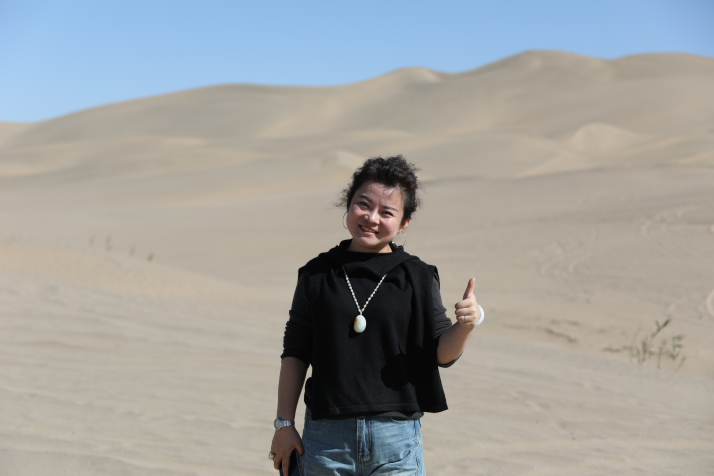 Ai Yunqi poses for a photo in a desert in Hetian (Hotan) Prefecture on October 20, 2024 (COURTESY PHOTO)
Ai Yunqi's story "Lift your veil and let me see your brows, so slender and long, like the crescent moon hanging on a branch..." I was just a kid when I first heard this famous Xinjiang folk song, Lift Your Veil, crackling from an old TV set. I hummed along a few times and noted the script down. As I sang, I'd picture the girl in the lyrics, and I remember thinking Xinjiang, so faraway, must be a mythical place filled with beautiful people, beautiful music. Back then, it was just another childhood tune. I had no idea that melody would plant a seed deep within me, which would slowly take root over the years, and eventually pull me all the way across the country to that vast land, where it would bind me in ways I could never have imagined. My real, enduring connection with Xinjiang started when I met Chen Ruijun, who once worked in Xinjiang as part of the paired assistance program—a national initiative launched in 1997 to provide financial, technological and personnel support for the region's development. We met by chance in Beijing at a New Year celebration in Xicheng District, when the Desheng Chamber of Commerce, a local non-profit social organization, needed a choir director for their performance, and I was brought in to rehearse and conduct them. We bonded over our shared love of music, and our friendship grew from there. Later, he asked me to sing a song he'd written: The Girl From Caochanggou. The lyrics were actually about my hometown in Gansu Province. The first time I read his words, I was genuinely moved. I knew he was a trained engineer (once majoring in inorganic materials in Zhejiang University) and a senior official at China State Construction Engineering Corp. Though not a writer by profession, he wrote frequently. His language was not fancy, yet these simple and honest words, quietly spoken, conveyed strong feelings. He wrote about Xinjiang's landscapes, about his years working there. Every line came straight from the heart. Reading him, I felt like I'd already crossed a thousand mountains and rivers, standing right at the foot of the Tianshan Mountains, stepping onto the warm earth of south Xinjiang. The first song of his I performed was, indeed, The Girl From Caochanggou. While I was recording it, I kept seeing this image: a young woman walking through the mountain breeze, endless green hills rolling behind her. When the recording ended, the warmth lingered. I marveled at how powerful his lyrics were, but it never once crossed my mind that I could write my own. It was Chen who kept pushing me, saying, "You love to sing, and you clearly care about Xinjiang. Why not try composing? Put what you feel into music." That got me thinking. I started from zero, teaching myself composition bit by bit. I'd stay up late into the night, tweaking every note, reworking draft after draft. Before long, my very first original piece, The Vow of Ayding Lake, finally came together. The day it was done, I put on my headphones and listened to it on loop for what felt like forever. I remember thinking: I can now use my own work to tell Xinjiang's stories. My first Xinjiang visit came when Chen and I went on a field trip to the region's Aksu Prefecture. As we drove south, the scenery shifted: Lush oases gave way to endless Gobi deserts, snow-capped mountains glinting in the distance... The whole world opened up around us. Our first stop was the Tomur Grand Canyon. Standing there in the valley, with wind brushing past my ears, I reached out and touched the reddish rock, rough and sun-warmed under my fingers. That's when his lyrics finally clicked. The beauty of this place isn't something you can read about in a book. You have to feel it under your feet, with your hands, on your skin. Over those next few days, we traveled far and wide, meeting many locals along the way. They didn't say much, but their eyes spoke volumes. The fruit they handed us was impossibly sweet, and their smiles were the warmest, most genuine thing you could imagine. Right beneath the Tomur Peak, a melody just came to me out of nowhere. After we got back, Longing for Tomur came together quickly. Then came The Kucha Girl, From Jiangnan to South Xinjiang and Magical Aksu. Every song is a souvenir of those trips, of all the faces and moments we carried home with us. 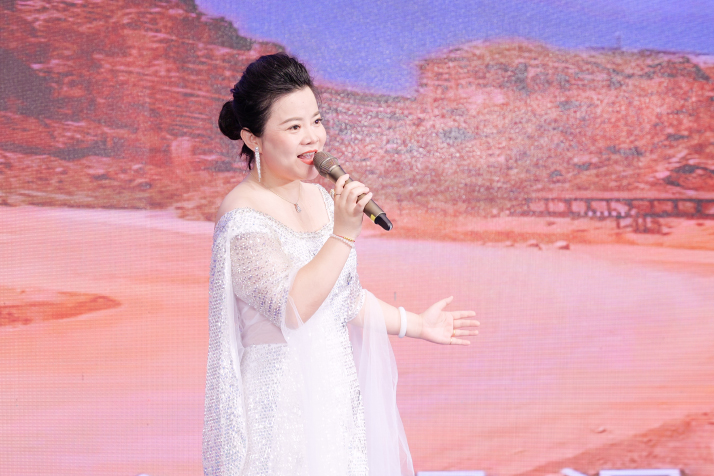 Ai Yunqi performs at an investment promotion event in Aksu Prefecture on June 14, 2025 (COURTESY PHOTO)
Hetian (Hotan) Prefecture was a whole different experience. Walking down the old streets of Tuancheng, past mud-brick houses with carved wooden doors and windows, old folks soaking up the sun, kids chasing each other and laughing—the everyday warmth of life just washed over me. Hetian's publicity department put together an original music sharing session for me. People from all backgrounds filled the seats, listening so intently, clapping with such warmth. The way old and young showed their appreciation was so pure, it made my heart ache. That day, I got to hear the Twelve Muqam, the most classical musical art form of the Uygur people, live for the first time: elderly musicians plucking the dutar, a traditional long-necked, two-stringed lute, their voices lilting and timeless, carrying centuries of stories. I stood there, just awestruck. Pushing deeper into south Xinjiang, we made it to Minfeng County. Standing at the edge of the Taklimakan, seeing sand stretching to the horizon and feeling wind brushing grains against my cheek, I really understood what boundlessness and resilience mean. We visited the Niya ruins, where ancient relics stand silent in the desert, holding stories from millennia ago. After we came back, the songs The Niya Girl and Andier Melon were finished in no time. I wanted to share that tenderness hiding in the heart of the desert and that sweetness growing on the Gobi, with as many people as possible. Over the years, we've ventured farther and farther into the region. There's Urumqi, a lively, welcoming city full of soul. I'm currently working on a song, trying to bottle that city's hustle, bustle and humanity into music. People ask me all the time: You weren't born in Xinjiang, how come you care about it so much? I always tell them: The more I visit, the more songs I write, the more friends I make, the more it starts to feel like home. And it's true. Xinjiang is no longer that place I used to imagine in childhood songs. It's the gravel I've walked on, the trees I've touched, and the fruit I've tasted. It's the honest smiles, and the years woven into each melody. 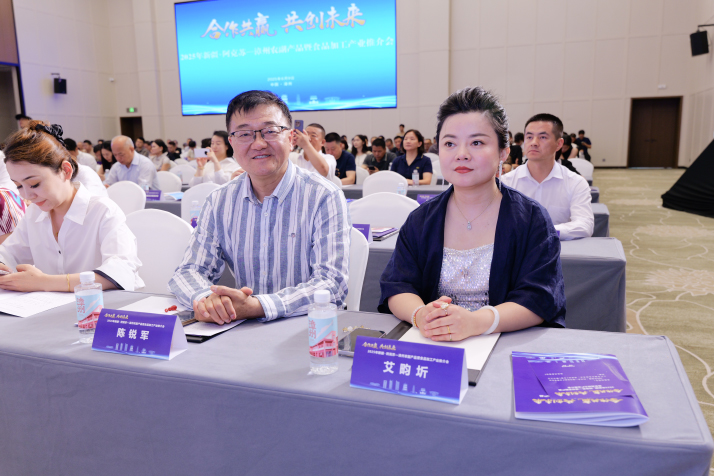 Ai Yunqi (right) and Chen Ruijun (second right) attend an investment promotion event in Aksu Prefecture on June 14, 2025 (COURTESY PHOTO)
Chen's story Ai went from being someone who just loved to sing to a composer with multiple award-winning original works under her belt in just over three years. Most people would call that unbelievable. But watching Ai, I saw it happen with my own eyes. To me, her story is a grassroots version of the Chinese Dream, plain and simple. When I saw how naturally gifted she was, and how painstakingly meticulous and persistent she could be, I suggested she try her hand at composing. I figured she might have some original work in her. I certainly didn't expect that The Vow of Ayding Lake, a song steeped in Xinjiang flavor, would come out so quickly and become an anthem for Tulufan (Turpan) and beyond. Then came more songs on different regions of Xinjiang, one after another. People around her were amazed. And now the song Return to Hetian is really taking off—its popularity just keeps growing. All over social media, people are pairing their own favorite images of Hetian with the song, creating heartfelt fan-made music videos one after another. Ai is already setting her sights on places beyond Hetian and Aksu, toward Urumqi, Tumushuke City, Yili (Ili) Kazak Autonomous Prefecture, Tacheng Prefecture and more of Xinjiang's stunning places. I have no doubt that the songs we create together will spread across this beautiful land and far beyond. Comments to luyan@cicgamericas.com |
|
||||||||||||||||||||||||||||
|