
|
| Xinjiang Today |
| How two writers turned aid work into a lifelong cultural mission | |
|
|
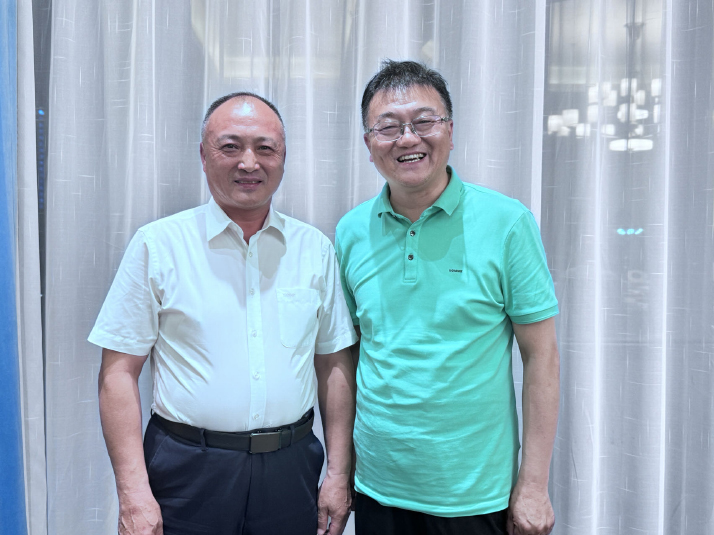 Ji Guilin and Chen Ruijun (COURTESY PHOTO)
Long after their official assignments ended, Ji Guilin and Chen Ruijun still talk about Xinjiang, not as a workplace, but as a lasting emotional homeland. The two men first met through a magazine and a website dedicated to officials participating in China's aid program in Xinjiang. Launched in 1997, the program is part of a nation-wide program that pairs wealthier regions and state-owned enterprises with specific impoverished regions to provide targeted, long-term support. What began as a professional exchange between an editor and a contributor gradually evolved into a friendship grounded in literature, photography and a shared commitment to cultural exchange. Today, both are retired from public service. Yet they continue to write, photograph and promote stories about the region and its people, hoping to preserve memories of an era when thousands of officials, teachers and professionals from across China traveled west to work in Xinjiang under national assistance programs. Their story also reflects the less publicized aspects of the aid program: Alongside infrastructure and economic development, the initiative fosters personal relationships, artistic collaboration and cultural dialogue. 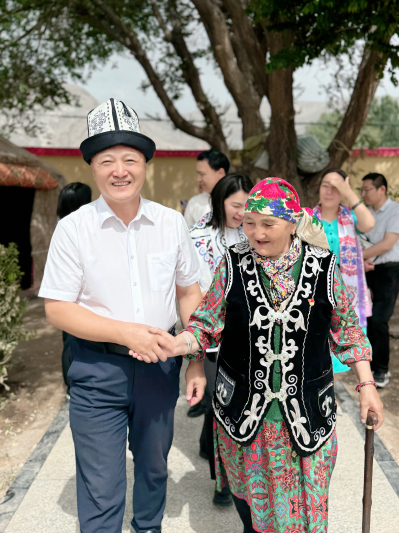 Ji Guilin visits Burumahan Maoleduo, a border patrol guard in Wuqia County, Kezilesu (Kizilsu) Kirgiz Autonomous Prefecture (COURTESY PHOTO)
A literary connection across the desert Ji, born in Tacheng Prefecture in Xinjiang, spent much of his career working in local government and later in the Communist Party of China (CPC) Xinjiang Uygur Autonomous Regional Committee's Organization Department, which is responsible for the admission and education of Party members and the selection of officials. But outside of his official duties, he pursued creative interests with unusual persistence. He wrote poetry and essays, practiced calligraphy and seal carving, and developed a passion for photography. In the early years, suitable materials for traditional seal carving were difficult to find in the remote border region, so Ji improvised by carving stamps into bars of soap before eventually obtaining stone materials brought back from other parts of the country by friends. By the late 1990s and early 2000s, Ji had become involved in editorial work for Xinjiang's Party-building (capacity building and self-improvement within Party organizations) publications. He later joined offices responsible for coordinating aid programs in Xinjiang, where one of his key responsibilities included editing the Yuanjiang Gongzuo magazine, a specialist publication dedicated to documenting, guiding and coordinating the national aid-to-Xinjiang program, and managing an online forum known as Yuanjiang Ganbu Zhijia, or "Home of Officials Assisting Xinjiang." At the time, the publication and website became important platforms for thousands of officials dispatched from Central Government agencies, state-owned enterprises and provinces across China. Among the contributors was Chen Ruijun, then a senior official from China State Construction Engineering Corp. working in south Xinjiang. Chen arrived in Xinjiang in 2008 as part of the sixth cohort of officials assigned to the region. Like many newcomers, he faced the challenge of adapting quickly to unfamiliar landscapes, cultures and working conditions. "We were dispatched across different prefectures and institutions almost immediately after arriving," Chen told Xinjiang Today. "Everyone wanted to learn from one another and understand how to do meaningful work here." Photography and writing soon became his way of documenting the experience. Carrying a professional camera wherever he went, Chen captured images of deserts, villages, markets and local communities. He also kept detailed notes about daily life, work encounters and emotional impressions from his time in Xinjiang. Before long, his essays and photographs began appearing regularly in Yuanjiang Gongzuo magazine and on the Yuanjiang Ganbu Zhijia. The exchanges helped create an informal literary community among the dispatched officials. Articles, poems and photographs circulated widely among participants, offering moments of reflection beyond administrative reports and policy discussions. For many, the platform became both a creative outlet and a support network far from home. "Ji became a kind of host for the whole community," Chen said. "Whenever I traveled to Urumqi, he would gather several friends together for conversation, poetry, music and discussion. Those evenings made people feel connected." 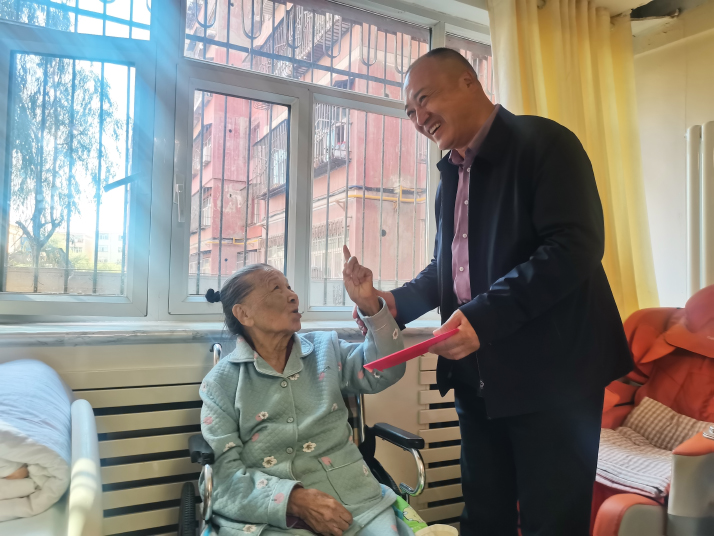 Ji Guilin (right) visits a nursing home in Xinjiang (COURTESY PHOTO)
Beyond official assignments For both men, Xinjiang eventually became more than a posting. Chen said the region's vast landscapes and diverse ethnic cultures deeply influenced his creative work. Over the years, he published several books inspired by his experiences, including collections of essays and memoir-style reflections about his work and friendships formed in Xinjiang. He also wrote song lyrics centered on themes of unity, memory and regional identity. Several songs drew directly on places he had visited, including Hetian (Hotan) and Aksu prefectures. His contributions earned official recognition during and after his assignment. Chen was named an outstanding aid official and received a second-class merit citation. In 2012, he was selected as a national youth role model by the Communist Youth League of China, an organization of advanced young people under the leadership of the CPC. Yet colleagues say what distinguished him most was not the awards, but his continued connection to the region after returning to Beijing. "Some people finish an assignment and move on," Ji said. "Chen never really left Xinjiang emotionally." The two remained in close contact over the years. Whenever Chen returned to Xinjiang for work visits or research trips, he met with old friends to exchange writing ideas, discuss photography and revisit memories from the aid years. Meanwhile, Ji continued supporting literary and artistic activities connected to Xinjiang. Friends describe him as someone who quietly encouraged younger writers and helped preserve stories that might otherwise have been forgotten. The friendship also extended into broader cultural and charitable activities. Chen became involved in public welfare projects through volunteer organizations in Beijing. One of his novels, inspired by real events in high-altitude border regions, was later adapted into a film screenplay that received recognition at the prestigious Xia Yan Cup Film Script Awards. Even after retirement, both men remain active writers. Chen continues publishing online under the pen name Lantianxiadexinjiang, or "Xinjiang Under the Blue Sky," while Ji remains engaged in cultural circles linked to calligraphy, photography and regional literature. Shared memories, shared future Observers of China's aid programs often focus on economic investment, industrial cooperation and infrastructure projects. But scholars increasingly note the importance of softer cultural connections formed during these exchanges. The friendship between Ji and Chen illustrates how long-term relationships can emerge from official initiatives. For many aid workers sent to Xinjiang over the years, the experience involved not only professional responsibilities but also personal transformation. Living and working in unfamiliar environments encouraged some participants to develop lasting ties with local communities and with one another. In Chen's view, literature and art played a unique role in preserving those experiences. "Statistics and reports tell only part of the story," he said. "Writing and photography help people remember emotions, encounters and shared moments." Ji agrees. He believes creative expression gave many aid workers a way to understand Xinjiang more deeply and communicate those experiences to audiences elsewhere in China. Looking back, neither man speaks primarily about career achievements. Instead, they remember late-night conversations, improvised poetry gatherings and the friendships formed across thousands of kilometers. (Print Edition Title: A Bond Forged in Xinjiang) Comments to luyan@cicgamericas.com |
|
||||||||||||||||||||||||||||
|