
|
| Xinjiang Today |
| Where the rivers meet: an evening inside Jiaohe | |
|
|
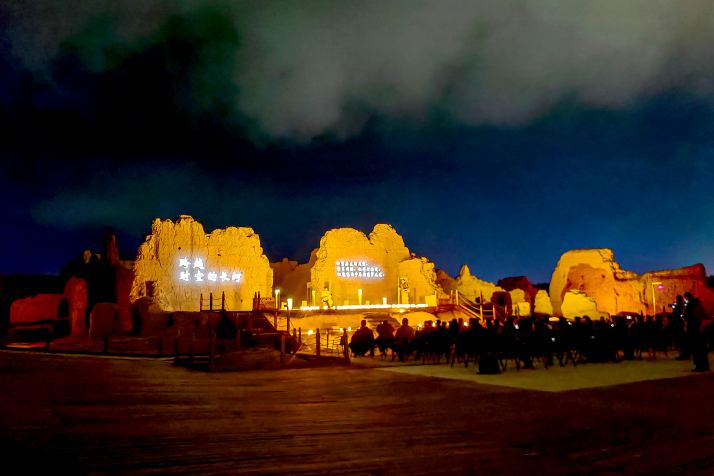 A Jiaohe Night performance in October 2025 (VCG)
We arrived while there was still light. Not the murderous light of the Tulufan (Turpan) afternoon, that particular sun that turns the Taklimakan into an iron skillet, but the softer, amber light of early evening, when the loess walls of Jiaohe glow as if lit from within. The ancient city received us gently at this hour. Its paths were wide enough, its silhouettes still readable against a sky slowly turning the deep blue of lapis lazuli.
Jiaohe, whose name means simply "where two rivers meet," sits on a natural plateau 30 meters above two dry riverbeds, 10 km west of downtown Tulufan. It was not built so much as excavated: Its founders, the Cheshi people, hollowed the city downward from the living earth, carving streets, homes, temples and administrative buildings directly into the loess. It was abandoned in the 14th century after the Mongolian invasions, and the desert, in its extraordinary dryness, preserved it. Walls, alleyways and the stupa of the Great Buddha Temple, all remain. It is a city that has been waiting, with great patience, for 2,000 years. The night event at Jiaohe, officially titled Jiaohe Night, unfolds in three movements: the approach, the performance and the return. What it aims to be, and what it actually becomes in the hands of 100 tourists on a summer night, are two related but distinct experiences. Into the light We walked in from the southern gate with daylight still lingering. Small lanterns lined the path, their flames not yet visible against the brightness, their purpose not yet apparent. Verses and meditations would be projected onto the ancient walls, but the sun had not yet surrendered enough of the sky for them to appear. We passed them unknowingly, as one passes many things whose meaning only becomes clear on the return journey. The city held us quietly. The loess walls rose on either side, warm and massive, carved not by hands but by the slow, negative labor of removal, a civilization that had chosen to go inward rather than upward. In this it resembles certain ways of thinking that the Silk Road carried back and forth along its length. The idea that depth, not height, is where meaning lives. 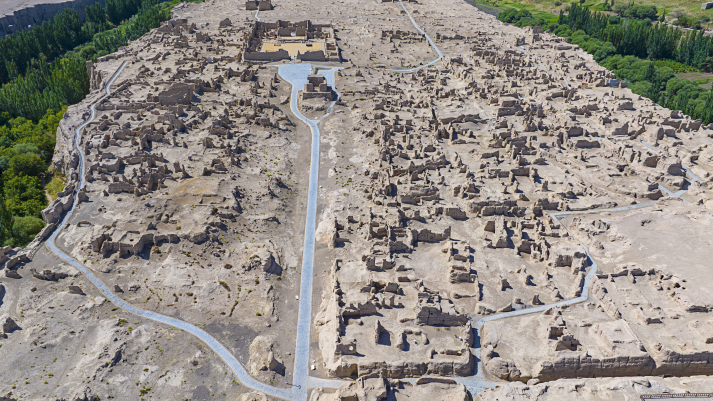 An aerial view of the Jiaohe Ancient City Ruins in Tulufan (Turpan) on June 25, 2024 (VCG)
A touch of Muqam The performance takes place in front of the ruins of the Great Buddha Temple, in a natural space formed by the ancient walls. We sat facing a low stage, really just a raised section of ancient earth enhanced with a wooden structure, where two performers appeared in silhouette against a wall lit in deep amber. Behind them, in the niches of the ruined temple, small Buddhist figures were illuminated: witnesses from another century. The music is rooted in the folk traditions of Tulufan, with a touch of the Uygur Muqam, that ancient, UNESCO-listed compendium of melody, poetry and rhythm that is the musical memory of the Silk Road. Just a touch; this is not a Muqam recital. It is something more intimate and more eclectic, closer to a musical meditation on place. The stringed instruments, a rawap, its long neck catching the light, and what appeared to be a dutar, were played without amplification. This is the most significant artistic decision of the entire evening, and it is the right one. Without microphones, the music existed at its natural scale. Close, human, requiring the listener to lean in rather than lean back. One of the pieces was a song called Ananurhan, a lament whose words were projected in fragments onto the walls as it was sung: You are my kind and beautiful girl Ananurhan, the bride drifting toward the wind Now I am alone Who would know how much I am troubled inside. The words are a translation, imperfect as all translations are, but the melody carried what the words could not: a particular quality of longing that seems indigenous to desert cultures, as though the landscape itself generates a specific frequency of melancholy. The host, dressed in a monk's robe, embodied the figure of Xuanzang, the Tang Dynasty (618-907) pilgrim who walked through this very city in 629 on his 17-year journey to India in search of Buddhist scriptures. It is a graceful conceit. The figure of the eternal traveler, passing through a place that will outlast him, meditating on what it means to be in motion. Xuanzang's journey would later be fictionalized as Journey to the West, one of China's four great classical novels. Here, he was simply a man walking slowly through the dark. 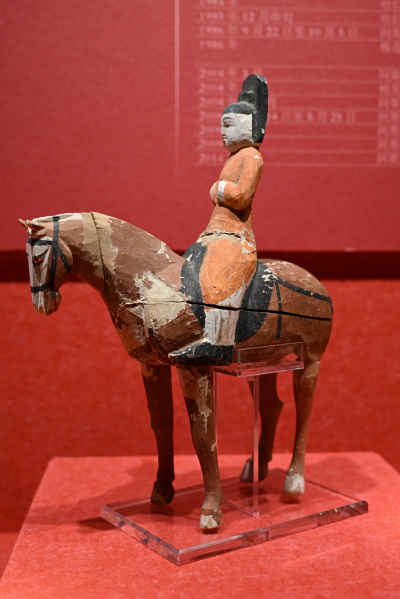 A Tang Dynasty (618-907) sculpture unearthed from an ancient tomb in Tulufan depicts an upper-class lady from the Western Regions, the name by which Xinjiang was known at the time (VCG)
An honest reckoning Somewhere to our left, a small child exercised its right to exist loudly. Somewhere to our right, a phone screen glowed with the unmistakable brightness of someone scrolling. Behind us, a camera shutter clicked with the persistence of a determined insect. The creators of Jiaohe Night have built something genuinely thoughtful and, in places, genuinely moving. They cannot be held responsible for the attention spans of their audience. This is perhaps the central paradox of all heritage tourism. The more carefully a place is prepared for contemplation, the more people arrive to contemplate it, and the more those people collectively make contemplation difficult. Jiaohe Night asks for stillness and receives, instead, the ordinary human noise of a group of strangers gathered in the dark. The performers, to their considerable credit, seemed entirely untroubled by this. They played as if in an empty city, which, in the only sense that mattered, it was. Candles and the clockwise path The final movement was participatory. We were each given a candle, a sizeable, dignified object, its simulated flame trembling with convincing imitation of life, and were invited to walk clockwise around the square precinct of the temple before depositing our candles in one of the ancient niches carved into the walls. The clockwise direction is not accidental. In Buddhist tradition, circumambulation—walking around a sacred space in the direction of the sun—is an act of devotion and alignment. It appears in Hinduism as pradakshina, in Islam as the tawaf around the Kaaba, in the great pilgrimage traditions of nearly every culture that has ever organized itself around a sacred center. The Silk Road passed through all of these traditions. Jiaohe has been, at various points in its history, home to adherents of most of them. To walk clockwise here is to participate, however lightly, in something very old. And then, on the walk back, the city revealed what the daylight had concealed. The lanterns along the path were visible, casting pools of warm light across the ancient earth. And on the walls, projected in luminous blue-white against the ochre loess, the verses appeared at last. "Looking up at the sky of history, stars twinkle like flickering lamps, as if they are the light of chasing dreams for 2,000 years." Further along, larger, across a wall that rose against the now fully dark sky. "Life is not an end; there is no endpoint for cultivation—it's not about meeting someone else, but about encountering your best self." The Chinese original uses the word xunli, meaning "pilgrimage." We had been on one all along, without quite knowing it. The texts we had walked past unseeing on the way in were waiting for us on the way out, which is, when you think about it, how most important things work. The bus back to the hotel was quiet, not entirely from exhaustion, we think, but from something less easy to name. We had not understood the words of the songs, nor the full meaning of the recitations. But that, it turned out, was not required. Ancient poetry does not ask to be translated in order to be felt. It has its own sufficiency, its own beauty that arrives before comprehension. It is like a piece of music that moves through you before you have found a word for what it means. Not understanding the language is simply not the same as not receiving what is said. The performers of Jiaohe Night know this. The city knows it too. The noisy visitors know it as well, though perhaps the knowledge has not yet settled into silence. It will. XT The author is chairman of the West-East Urban Governance Institute, an independent research organization focused on urban governance, city resilience and sustainable urban futures in Greece Comments to yanwei@cicgamericas.com |
|
||||||||||||||||||||||||||||
|