
|
| Xinjiang Today |
| In Xinjiang, dance speaks as loud as words | |
| Shared rhythms across cultures | |
|
|
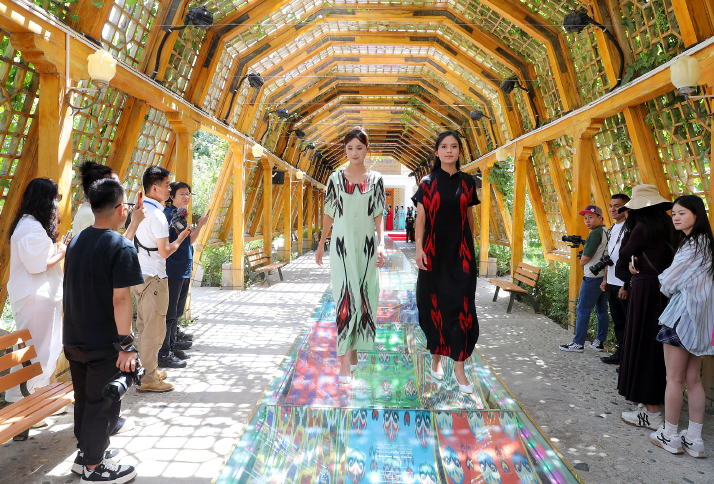 Local farmers showcase Atlas silk garments in Hetian (Hotan) City, Hetian Prefecture, on June 29 (VCG)
In this piece, two international travelers capture the vibrant essence of Xinjiang, from spontaneous invitations to join folk dances to the heartfelt warmth of local children, artisans and vendors. Through their personal observations, they seamlessly weave together themes of cultural diversity, social stability and everyday joy, offering an intimate portrait of the region where tradition flows naturally into modern life. Jay Kerekes, a Canadian content creator with Slovakian origin If you ask me what Xinjiang is, I would say this: Xinjiang is a dance that pulls you into the circle before you even have time to learn the steps. I am from Slovakia and Canada, and I often describe myself as a global citizen. But in Xinjiang, that phrase took on new meaning. I was not a distant foreign visitor watching life from the outside. Almost instantly, I felt that I had been invited in. One moment in Urumqi, the capital city of Xinjiang, still stays with me. I was walking through a park when a young man approached me and invited me to join a Xinjiang folk dance, not with many words, but with his eyes, his gestures and the energy of the music. Before I had time to think, my body was already moving. Later, when a friend asked me to describe my reaction, I said, "First came surprise, and then came, 'Wow, how great!'" That, in many ways, became my normal state in Xinjiang: Always surprised, always happy. Before coming here, like many foreigners, I had only fragments of an image. Xinjiang can be described from far away in simple terms, but on the ground it is far more vivid and human. At Hetian Er Street in Urumqi and later in Moyu County of Hetian (Hotan) Prefecture, I found not distance but closeness, not silence but curiosity, not separation but welcome. In Moyu, children gathered around me, eager to know where I came from. They taught me a few Uygur phrases, starting with "hello" and "goodbye," and then invited me to join them for a soccer game. When it was time to leave, they were disappointed, and I found myself thinking: Next time I come, I should stay a few more days. One small encounter revealed Xinjiang to me more powerfully than any speech could. Most of the children were open and quick to interact, but one boy was shy. He came over and asked me in Chinese, "Can I shake your hand?" Then, after a pause, he asked if I could also shake his brother's hand, because his brother was too shy to come forward himself. In that moment, I felt something simple and profound: In Xinjiang, it is not only the scenery that is beautiful. The people are even more beautiful. I mention children because they represent the future. If the children of Xinjiang are outgoing, confident, curious, kind and considerate, then the future of this land is bright. Their openness reflects something larger: a society where different cultures meet not as strangers, but as neighbors. Of course, Xinjiang is also a place shaped by stability. As a visitor, I could feel the importance placed on safety, order and counter-terrorism efforts. But what mattered most to me was the everyday result: people dancing in parks, children playing, families enjoying food and visitors moving through public spaces with ease. Stability, when seen at street level, is not an abstract policy word. It is the condition that allows ordinary life to unfold. Three things made me want to "scream" with joy: nature, dancing and food. In the Kunlun Mountains, the vast open landscape took my breath away, metaphorically and, because of the altitude, almost literally. I am a free spirit, and those open spaces felt like freedom itself. (Stretching across west China, the Kunlun Mountains are renowned for their awe-inspiring landscapes and towering snow-capped peaks that soar to elevations of over 7,000 meters, alongside expansive glaciers and rugged alpine terrain—Ed.) Then there was the dancing. Before coming to Xinjiang, I did not know that dancing could feel so natural in public life. Wherever I went, people moved with rhythm and confidence and somehow I joined in too. Finally, there was the food, especially the spicy dishes and lamb skewers that turned even casual conversations into laughter. In Xinjiang, even a debate over whether skewers go better with beer, liquor or yogurt can become a joyful cultural exchange. When asked what I would take home, I thought of intangible cultural heritage, perhaps a handmade carpet. I almost bought one. The price made me hesitate, but I understood its value. It was not just an object. It was memory, labor, identity and art woven together. I have traveled to many places, but Xinjiang gave me a rare feeling: Even as a foreigner, you can quickly become part of it. Its young people are confident and cheerful, curious about the world and eager to share the best of themselves with others. That is the Xinjiang I saw: open, diverse, energetic and deeply human. And I will definitely come back.  A commercial street in Hetian City on June 29 (VCG)
Iain Inglis, a content creator from the UK The moment that made me stop in Xinjiang was not a mountain, a desert, or a landmark. It was a sound. I was having lunch at a well-known Hetian baked bun restaurant, already pleased to be eating a food I had heard about long before I had arrived in Xinjiang. The buns were delicious, but halfway through the meal, something else caught my attention: a rhythmic, unmistakable call from the background. It sounded almost like shouting, but with purpose and pattern. I remember asking myself, "What on earth is that?" So I went outside to see. That was when I watched the bakers pull the hot buns from the oven, place them into a large basket, walk across the room, and release them onto the windowsill while making that distinctive vendor's call. Perhaps it was a way to attract customers. Perhaps it was simply part of the restaurant's daily rhythm. But for me, it became one of those rare travel moments when a place suddenly reveals itself. My first thought was simple: "Wow, I'm really in Xinjiang." That sound told me something no formal introduction could. Xinjiang is not only scenery. It is living culture, heard in a vendor's call, felt in the hands of artisans, and carried through music, food, craft and memory. I felt that again in the Kunlun Mountains. The mountains were vast and beautiful, but even there, surrounded by nature; I found myself thinking most about people: How they live here, what they preserve and what they pass on. What moved me most during this journey was Xinjiang's intangible cultural heritage. In many places around the world, modernization can quietly erase tradition. I have seen it happen. On the island of Borneo in Southeast Asia, I once witnessed an Iban village disappear, along with traditional rice cultivation practices. Once such things vanish, they are almost impossible to recover. Xinjiang, however, offered me a different lesson. Here, I saw young people continuing to play music and learn dances. I saw traditions not locked away for tourists but practiced as part of daily life. That matters. A culture survives not because it is praised in speeches, but because ordinary people still use it, teach it and take pride in it. At the Jade Museum in Hetian, I was reminded of a sharp contrast. Jade is not renewable. Once it is fully extracted, it is gone. Traditions, by contrast, can be renewed—but only if people actively preserve them. They need hands, voices, teachers, students and a social environment that allows them to continue. Xinjiang, from what I saw, is making that effort visible. One of the clearest examples came at a carpet factory. The women working there were local villagers, and through the factory they had stable jobs and income. But the work was not only economic; it was cultural. They were practicing weaving techniques passed down through generations, turning inherited skill into livelihoods. Through these carpets, Xinjiang's culture travels far beyond the region—across China and even internationally. I tried weaving a carpet myself. It took me about 10 minutes to tie just four knots. A friend kindly said, "Well done," but I knew the truth: Beside the skilled artisans, my effort was almost nothing. Yet that small experience made the craft more real to me. A carpet is not just a product. It is patience, memory, discipline and identity tied together by hand. This is where Xinjiang's development becomes especially interesting. Modernization is often described in terms of buildings, roads, energy and infrastructure, and Xinjiang has all of that. But development is at its strongest when it does not sever people away from their roots. The support I saw around heritage preservation was organized and intentional. In a world where children can easily drift toward phones, tablets and global sameness, protecting local culture requires more than nostalgia. It requires structure. Security and stability also form part of this picture. Xinjiang's counter-terrorism efforts and emphasis on public order are clearly treated as foundations for normal life. Whatever one's starting assumptions may be, on the ground I saw people working, learning, cooking, weaving, dancing and welcoming visitors. Stability, in that sense, is not an abstract idea. It is what allows daily culture and economic life to continue. Xinjiang is not a single story. It is many ethnic groups, many traditions, many landscapes and many hands at work. I feel honored to have heard one small voice among them, the vendor's call of a baked bun maker in Hetian. To me, it said something powerful: Xinjiang's past has not disappeared, and its future is arriving. XT Comments to zhaowei@cicgamericas.com |
|
||||||||||||||||||||||||||||
|