
|
| Xinjiang Today |
| Changji--the closest prefecture to Urumqi | |
|
|
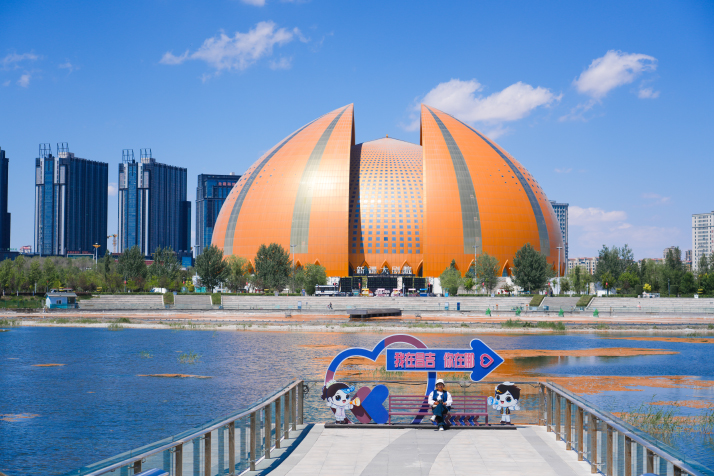 The Xinjiang Grand Theater, a landmark in Changji Hui Autonomous Prefecture (VCG)
Xinjiang is vast and sprawling, with most prefectures and counties lying hundreds or even more than 1,000 km away from the regional capital, Urumqi. The Changji Hui Autonomous Prefecture is an exception, which embraces Urumqi from the east, west and north, with its seat of government being just more than 30 km from Urumqi's city center.
This unique geographical position is only one part of Changji's distinct identity. The thousand-year cultural legacy of the ancient Beiting Protectorate of the Tang Dynasty (618-907), its emerging role as a computing power hub oriented toward Central Asia, and its distinctive Hui ethnic culture together form the unique character of this land at the northern foot of the Tianshan Mountains.  From downtown Urumqi, people can catch a distant view of the Tianshan Mountains located in Changji (VCG)
So near, so beautiful The vastness of Xinjiang often turns a trip from Urumqi across prefectures into a long-haul journey—except for Changji because of its geographical proximity. The Urumqi-Changji area has been a pioneer in Xinjiang's development of metropolitan circles, with interconnected arterial road networks and continued progress in industrial coordination and public service sharing. With broad expanses of oases, mountainous terrain and desert, Changji has become an "everyday" travel destination for residents of Urumqi. Landmarks such as Tianchi Lake on the Tianshan Mountains, Jiangbulake scenic spot featuring glaciers and mountains, and the Liuhuanggou Danxia landforms all lie within a two-hour drive from Urumqi, making it one of the rare natural scenic belts in Xinjiang that can be visited on a weekend round trip from the regional capital. Visitors can experience the grandeur of the Tianshan Mountains. From the glaciers of Bogda Peak to the sand dunes of the Gurbantunggut Desert, multiple natural zones can be crossed within 100 km. This accessible magnificence, woven into the fabric of everyday life, is a character unique to Changji.  Danxia landforms in Changji Hui Autonomous Prefecture. Danxia landforms characterized by spectacular red cliffs are unique to China (VCG)
A hub of computing power In addition to natural beauty, Changji happens to have natural advantages in the two core aspects of the computing power sector—electric power and cooling. It has abundant and low-cost green electricity: By the end of 2025, the installed capacity of new energy in the prefecture had exceeded 32 million kilowatts, accounting for nearly one fifth of Xinjiang's total new energy capacity. The wind and solar resources are stable throughout the year, and electricity costs are much lower than in the eastern regions. In addition, thanks to its high altitude, long winters and low annual average temperature—characteristic of a continental climate—energy consumption for server cooling is significantly reduced. The Gobi desert is naturally a "large cooling data center that saves on electricity bills." The Xinjiang International Integrated Supercomputing Center has grown in exactly such conditions. At present, the peak computing power of the project's first phase has exceeded 2,000 PetaFLOPS (P); and once the second phase is fully completed, the total scale will reach 10,000 P. To put it in intuitive terms: An ordinary user would typically have to wait several minutes for a home computer to generate a one-minute high-definition AI video, but the computing center, with just its first-phase capacity, can simultaneously process thousands to tens of thousands of such video tasks in parallel, easily completing over 30,000-minute-long 1080-P AI video generation tasks in a single day. Its total computing power is equivalent to tens of thousands of home computers running at full load simultaneously. Unlike the positioning of the computing power industry in regions such as Karamay and Hami in Xinjiang, Changji, riding on the development of the China-Central Asia computing community, is serving as Xinjiang's cross-border computing gateway facing Central Asia and beyond. "In the future, our service will extend from the heart of Central Asia to the African continent. Leveraging our mature satellite remote sensing computing capabilities, we will provide precise data for locust plague early warning, national land surveying and mapping, and disaster prevention and control across the African savannah," said Tang Shuheng, head of the center. The supercomputing center will continue to expand its dedicated cross-border computing services, so that its clean, efficient and inclusive computing resources will reach more countries and regions involved in the Belt and Road Initiative. 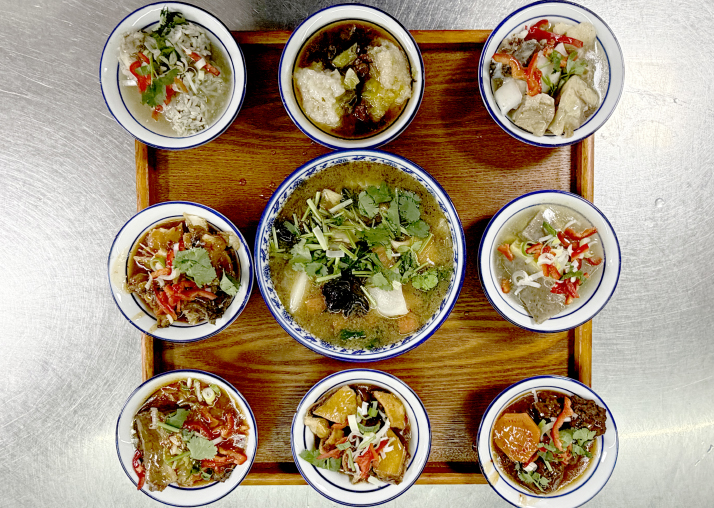 Some of Changji's signature dishes (VCG)
The Hui culture Along the old streets of Changji, in the early morning, the pastry shops at the alleyways are always the first to stir. Freshly fried oil-fried pancakes come out of the wok crisp on the outside and soft on the inside, while neatly coiled fried dough twists carry the toasty aroma of wheat. This is an ordinary breakfast in the locality, yet it bears the unique imprint of the vibrant everyday life of Changji's—the only Hui Autonomous Prefecture in Xinjiang Uygur Autonomous Region, and one of just two such prefectures in all of China. Food is the most vivid carrier of culture. On occasions such as weddings, funerals or when entertaining guests from afar, nine exquisitely prepared dishes are arranged in a three-by-three grid—this is the most solemn gesture of hospitality in the locality. Among the Hui people in Xinjiang, a saying goes: "Nine dishes in three rows—eating them brings you face," which speaks to the esteemed status of this traditional banquet style. Under China's system of regional ethnic autonomy, the cultural traditions and living customs of the local Hui people have been fully preserved and dynamically passed down through generations. This gives Changji a distinctive cultural character that naturally sets it apart from other parts of Xinjiang. While the oasis cities of south Xinjiang are steeped in rich Uygur culture, the grasslands of the Ili River valley are imbued with the nomadic traditions of the Kazak people, and in Changji, Hui culture stands out as a particularly vivid and defining feature. Hua'er is a representative form of Hui ethnic folk songs. Passed down for centuries, Hua'er has been inscribed as a Xinjiang autonomous regional-level intangible cultural heritage. These folk ballads require no elaborate accompaniment—they are transmitted orally through melodious singing, voicing the daily toil in the fields, the emotions of returning from afar, and the longing for a peaceful life. Alongside Hua'er, which has been systematically preserved and passed on, are Hui folk tales and traditional wedding customs and rituals. Together, they form a complete folkloric system and constitute an indispensable part of Xinjiang's diverse cultures. This culture has never existed in isolation. Changji is home to more than 30 ethnic groups, including Hui, Han, Kazak and Uygur peoples, who have lived side by side for generations—visiting each other during festivals and influencing one another's customs. This harmonious yet diverse interweaving has gradually settled into the unique social character that distinguishes Changji today. Comments to panxiaoqiao@cicgamericas.com |
|
||||||||||||||||||||||||||||
|








