
|
| Xinjiang Today |
| From cotton to drones: when farming meets technology | |
|
|
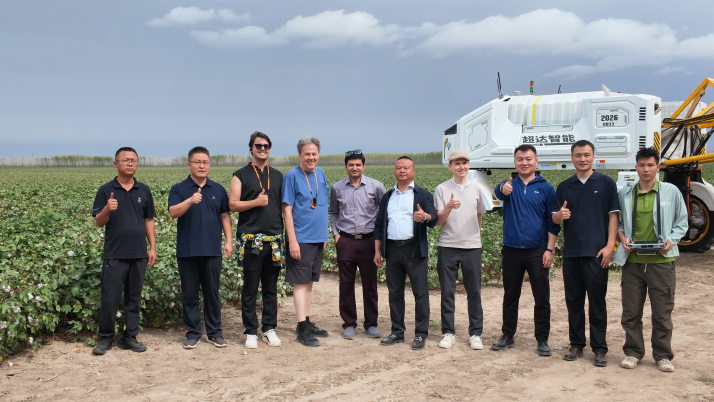 International journalists and local farmers pose for a photo in Fangcaohu, a large state-owned farm in Wujiaqu City administered by the Sixth Division of the Xinjiang Production and Construction Corps (YIN XIAO)
For centuries, the territory of Xinjiang lay along routes that connected China to Central Asia and, through them, to other parts of Eurasia. Goods, travelers, religions and knowledge circulated along the different paths we now call the Silk Road. Its geographic position remains strategic, but the region's economic role has taken on a new dimension.
This strategic importance was further enhanced by the Belt and Road Initiative (BRI). (Consisting of the Silk Road Economic Belt and the 21st-Century Maritime Silk Road, the BRI aims to boost connectivity along and beyond the ancient Silk Road routes—Ed.) The document that established the BRI's guidelines in 2015 designated Xinjiang as a core area of the Silk Road Economic Belt, taking advantage of its proximity to Central Asian countries and its role in linking Chinese and Eurasian markets. At the same time, the regional economy itself is growing and diversifying. In 2025, Xinjiang's GDP reached 2.15 trillion yuan ($321 billion), growing by 5.5 percent. Foreign trade reached a record 520.37 billion yuan ($72.85 billion), up 19.9 percent. Agricultural transformation is taking place alongside the region's industrial and commercial expansion. The agricultural base, however, is being transformed through mechanization, industrial processing and new technologies. Between August 31 and September 2, I was in Xinjiang and visited the places and companies mentioned in this article. I saw mechanized cotton fields, agricultural robots, large drones, smart greenhouses and different stages of agricultural processing. The visits offered a close look at how agriculture, industry, technology and education are connected in regional development. 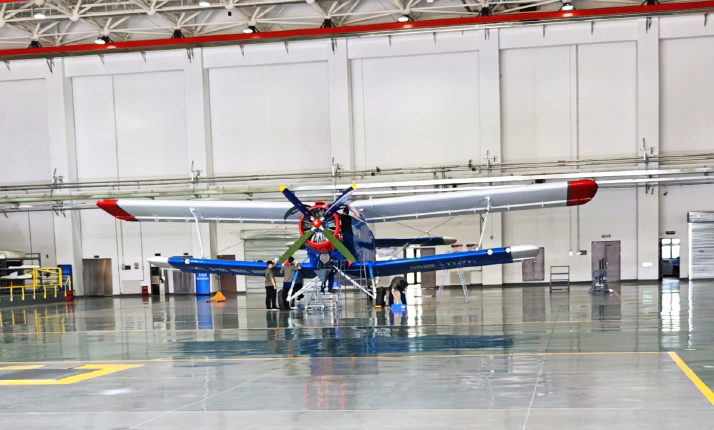 An agricultural drone developed by Ursa Aeronautical in Xinjiang to support field operations with greater efficiency and precision (WAGNER DANTAS)
Cotton powerhouse Cotton is one of the clearest examples of this transformation. In 2025, Xinjiang produced 6.165 million tons, about 92.8 percent of all cotton produced in China. Part of this production is concentrated in Fangcaohu, a large state-owned farm in Wujiaqu City administered by the Sixth Division of the Xinjiang Production and Construction Corps (XPCC). (The XPCC is a unique organization performing the functions of production, administration and border defense—Ed.) Fangcaohu is not simply an isolated agricultural outpost; it is an extensive production area, with communities, infrastructure and services integrated into rural development. In 2026, Fangcaohu had about 41,200 hectares planted with cotton. In some of these areas, 40 ground robots were used to apply defoliants with precision. These products are applied before harvest to make the cotton plant's leaves fall, thereby facilitating mechanized harvesting. In practice, modernization is visible at several stages of cultivation: Sensors monitor the fields, automated machines carry out tasks with greater precision and smart equipment reduces dependence on manual labor. The scale is striking, as is the level of mechanization. In 2026, the integrated mechanization rate for cotton cultivation and harvesting reached 97 percent. Among white rows stretching to the horizon, machines and smart systems take on tasks that once required a great deal of manual labor.  The author joins the local dancing crowd in a square in Shihezi (CHEN SANYI)
Agri-tech and manufacturing This modernization is also driving new industrial activities. In Shihezi, Percisphere, a private Chinese robotics and automation company, operates a production and assembly base for smart agricultural equipment. One of its flagship products is the Hechu T3000, an electric, modular agricultural platform that combines technologies such as AI, autonomous driving and data analysis, and can be fitted with different modules to perform a range of field operations. The equipment shows how demands arising from agriculture can stimulate research, engineering and manufacturing within the region itself. Also in Shihezi, Ursa Aeronautical, a private Chinese company specializing in large unmanned aircraft, develops models such as the HY100. Designed for agricultural and forestry protection, logistics, cargo transport and emergency operations, the drone boasts a maximum payload capacity of about 1.9 tons and a stated range of up to 1,800 km. It is a stark departure from the industries traditionally associated with Xinjiang's agricultural economy. The two cases show how agricultural modernization is driving engineering, robotics and equipment manufacturing. Building value chains In Wujiaqu, rural modernization takes different forms. In Fangcaohu, Xinjiang Lufeng Agricultural Industry Technology Development, a private agricultural technology company, uses greenhouses and advanced cultivation techniques to produce fruit and vegetables year-round, including during the harsh winters of north Xinjiang. The greenhouses allow factors such as temperature and humidity to be better controlled, reducing dependence on the seasons and extending the production period. Another example is Xinfa Modern Ecological Agriculture in Wujiaqu. The park is part of a circular economy model that directly connects industry and agriculture. Its industrial activities include power generation, a process in which not all the heat produced is converted into electricity. Instead of being wasted, some of the residual heat is channeled to greenhouses for winter heating. The reuse of resources is not limited to heat. Part of the carbon dioxide generated by industrial activity is also captured and directed to greenhouses, where plants use it in photosynthesis. In this environment, automated systems help control temperature, ventilation, irrigation and humidity. As a result, resources that would otherwise be wasted are put to work, growing strawberries, cherries and other high-value crops. It is a concrete example of how industry and agriculture can be seamlessly integrated. Diversification is also visible at Tangting Xialu Winery, a mixed-ownership company with both state and private capital. Founded in 2012 and located in a wine-growing area north of the Tianshan Mountains, it turns locally grown grapes into wine, adding processing, storage and bottling to the agricultural value chain. The winery has a 1,800-square-meter cellar and a stated annual capacity of 200 tons, or roughly 260,000 bottles. Its Beiting Cabernet Sauvignon 2021 received a gold medal at the Wynn Signature Chinese Wine Awards. Here, the agricultural chain yields not only economic value, but also flavor, memory and hospitality. I sampled nearly every wine the house produces; between the aromas, the glasses and the conversation, I almost didn't want to leave. The same logic can be seen in the food industry. Terun Dairy is a state-controlled dairy company affiliated with the 12th Division of the XPCC, employing more than 3,000 people. The company integrates different stages of the production chain, from forage cultivation and dairy cattle breeding to milk production and processing, research and development, logistics and the marketing of dairy products. This structure shows how the modernization of livestock farming in Xinjiang connects with industrialization and the addition of value to regional agricultural production. Knowledge, memory and everyday life Technological development depends on people. Universities and exchange centers help train professionals to operate and advance these activities. Shihezi University is an important center for teaching and research in a city whose history is deeply tied to agriculture. The BRI International Education Center, affiliated with the university, is dedicated to academic cooperation and international exchange under the initiative. The center hosts international students and researchers and runs training and exchange programs, bringing Xinjiang closer to countries in Central Asia and other regions. In this way, the circulation of knowledge and professional training complement roads, railways and logistics hubs. The size of the university helps give scale to its role. As of September 30, 2025, it had 34,024 students, including 523 international students, and 2,133 faculty members. In 2026, 2,403 graduates chose to remain in Xinjiang and the XPCC. Of this total, 1,224 went to work in local communities and institutions, including schools and public services. Seen up close, these are not mere statistics: They represent knowledge taking root in a region shaped by the long effort to transform its land. At Junken Culture Square in Shihezi, history and modernity converge in the memory of the pioneers who reclaimed land and developed agriculture beginning in the 1950s. The term junken, literally "military reclamation," historically refers to the cultivation of frontier land by soldiers and is deeply linked to the founding of the XPCC and the making of Shihezi. Among the square's monuments, The First Plow depicts pioneers manually pulling a plow to break the ground. The image creates a striking contrast with Xinjiang today, where agricultural robots, autonomous driving systems and large drones symbolize increasingly mechanized agriculture. At night, the square takes on another dimension and fills with residents who gather for cultural activities, music and group dances. Among them are distinctive rhythmic dances from Uygur culture, one of the many traditions that make up Xinjiang's cultural diversity. The space brings together the memory of the city's founding and everyday cultural life. Shihezi is also striking for its greenery. In 2026, the city counted 114 parks, a green coverage rate of 44.18 percent and 15 square meters of park area per resident. In a city built on the edge of the desert, trees and gardens seem to be more than decoration: They tell another part of the same story of transformation. Beyond the white cotton and the machines in the fields, it is greenery that fills the streets and offers shade to everyday life. The ancient Silk Road made Xinjiang a land of passage and encounter. Today, the region remains a gateway for opening up to the west, but on new foundations. Across the same spaces where horses and camels once traveled for centuries, international railways, logistics chains and new trade flows now move. Around them, mechanized fields, smart greenhouses, factories, universities and technology companies reveal a region in transformation. But behind the machines and the numbers are people: rural workers who rise early, face the cold, tend the land and follow every stage of the harvest; young people who study and choose to remain in the region; and families building their lives between the countryside, the city and the new opportunities brought by development. There is something simple and profound here: Technology can transform the way the land is cultivated, but it is people's hands that continue to give meaning to every harvest. The fields hold more than seeds; they also hold the effort, hope and future of those who make their living from them. In the end, perhaps this is Xinjiang's most important transformation: ensuring that development reaches people, improves everyday life and allows each new road, each new machine and each new harvest to open new possibilities for those who call this land home. The author is an editor with the Center for the Americas, China International Communications Group Comments to yanwei@cicgamericas.com |
|
||||||||||||||||||||||||||||
|