
|
| Xinjiang Today |
| Aksu: sweet to the core | |
|
|
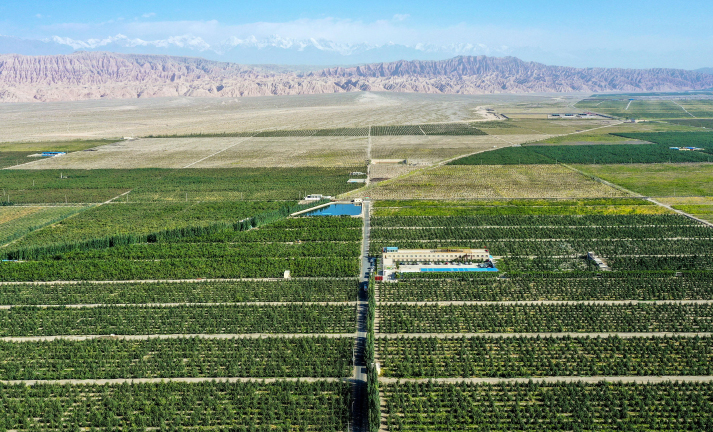 The Kekeya Afforestation Project in Aksu Prefecture on September 10, 2020 (VCG)
At the southern foot of the Tianshan Mountains and on the northern edge of the Taklimakan Desert lies a prefecture famous for its depths: Deep in its cliffs lie Buddhist grottoes older than those of Dunhuang in Gansu Province; oil workers drill as deep as 10 km under its surface, while deep within the local apples lie translucent cores of crystalline sweetness. This is Aksu, which means "clear, rushing water" in Uygur language. Covering 125,500 square km, it borders Kyrgyzstan and Kazakhstan to the west. 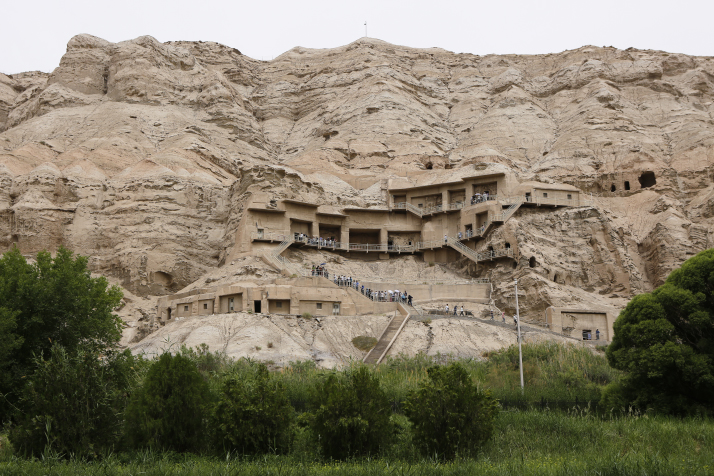 The Kizil Caves in Baicheng County, Aksu, on June 25, 2024 (VCG)
Deep in the cliffs In Baicheng County, Aksu Prefecture, the Kizil Caves were carved over a span of hundreds of years, starting from the third century, making them China's earliest large-scale grotto complex—even earlier than the Mogao Caves at Dunhuang. Today, 349 caves and over 4,000 square meters of murals remain. In 2017, Anaerguli, who is originally from Kizil, returned there to become a guide at the caves, leading visitors cave by cave with a flashlight. Each diamond-shaped panel depicts a story—the Monkey King saving his subjects, or sacrificing himself to feed a tiger—like comic strips pasted on the wall. She said these millennia-old murals taught her that one should be willing to think of others. This land was called Qiuci in ancient times and was one of the first stops along the Silk Road for the spread of Buddhism into China's Central Plains region, or zhongyuan. Kumarajiva, a famous Buddhist translator and eminent monk in Chinese history, was born here in the fourth century. The Pipas (traditional plucked instruments with fretted fingerboards), dance poses and garments depicted in the murals preserve traces of the merchants and travelers who passed between East and West through Qiuci. Today, conservators keep watch in the caves, working at millimeter precision to glue flaking and hollowed pigments back onto the walls, racing against time. Qiuci was a crucial hub for trade and cultural exchange along the ancient Silk Road. The historical sites of ancient Qiuci are spread across what are now Kuche (also spelled Kucha or Kuqa) and Aksu cities as well as Baicheng, Xinhe and Shaya counties in Aksu Prefecture. They can also be found in Luntai, Bayingol (Bayingolin) Mongolian Autonomous Prefecture neighboring Aksu Prefecture. Ten thousand meters below In the heart of the desert in Shaya County, the Shenditake-1 well, with drilling commenced on May 30, 2023, has reached a depth of 10,910 meters, becoming China's first ultra-deep scientific exploration well and Asia's deepest vertical well. Well manager Wang Chunsheng remembers the most dangerous moment: With the bit just 23 meters short of 10,000 meters, the some-300-ton drill pipe suddenly snapped, and the celebration instantly became an emergency. The team worked around the clock for days before clearing the fault. Finding oil underground is one thing; refining is another. In the national-level Kuche Economic and Technological Development Zone, Tahe Refining and Chemical, Sinopec's only refining and chemical enterprise in northwest China, refines 5 million tons of crude oil each year into gasoline for cars and aviation kerosene for aircraft. In 2024, the total output value of the Kuche development zone exceeded 55 billion yuan ($8.24 billion) for the first time. Also based in Aksu, Xingfa Chemical uses local natural gas to produce a solvent used in pharmaceuticals and electronics, reducing reliance on foreign technology and building the world's largest production base. Rewind to 1998, when Kela-2, then China's largest integrated gas field, was discovered in Baicheng, with proven natural gas reserves of 284 billion cubic meters, directly giving rise to the West-East Gas Pipeline, a game-changing project that delivers natural gas from west China to other parts of the country. Today, the Baicheng area supplies over 21 billion cubic meters of gas a year, about one 10th of the country's total natural gas output. Tarim's gas flows east along the pipeline, reaching millions of households in Shanghai. 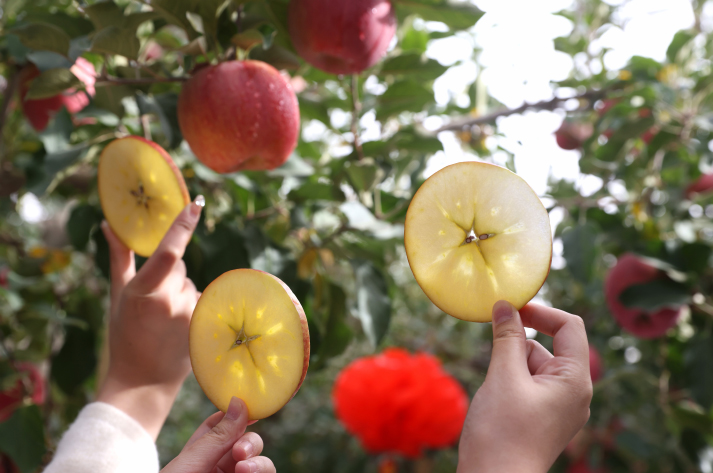 Slices showing the rock candy core of apples in Hongqipo, the heartland of the famed crystal sugar heart apple, in Aksu City, capital of Aksu Prefecture, on October 23, 2023 (VCG)
Sweet at the core "Truly out of stock." Du Minchao, chairman of an apple cooperative in Hongqipo in Aksu City, the heartland of the famed crystal sugar heart apple, could only wave helplessly at a buyer from Zhejiang Province who was pressing for delivery. Every year in late October, after Frost's Descent or Shuangjiang, one of the 24 solar terms on the traditional Chinese calendar, the apples in Hongqipo reach their peak quality. As the old fruit growers say, "After three frosts, the sugar core begins to form." The flesh around the core gradually turns a translucent amber color—this is the rock candy core. Chinese consumers' recognition of this sweetness is reflected in their willingness to pay. According to Du, his apples sell for 7 yuan ($1.04) per kg, 1 to 2 yuan ($0.15 to $0.3) more than those from neighboring production areas, yet every year they are snapped up as soon as they are harvested. In livestreaming sessions, consumers place orders enthusiastically. In just one evening, nearly 4,000 boxes of apples (usually ranging from 4 to 10 kg) were shipped across the country. Wang Lei, a buyer who has purchased apples in Hongqipo for years, said that 80 percent of the apples have rock candy cores. Consumer repurchase rates are particularly high, and there is never any worry about selling them. Today, Aksu has 36,000 hectares of apple orchards with an annual output of 970,000 tons. The region also grows 180,000 hectares of thin-shelled walnuts and 28,000 hectares of gray jujubes. Forming a forest Forty years ago in Aksu, sandstorms were known to "swallow" the city. After a single sandstorm, seedlings that had just sprouted in the fields would be completely buried. In 1986, in Kekeya Town, Wensu County, people carried kantuman (an iron farming tool used in Xinjiang) and pickaxes into the Gobi Desert. They first built a 16.8-km canal to bring water into the area; where the soil was too hard, they flooded it to soften it and then dug it out shovel by shovel. Song Jianjiang, a first-generation forest ranger, recalled that in the first year they planted about 133 hectares of trees. On saline-alkali land, they first dug trenches to suppress the salt; on clay soil, they drove shovels into the ground to create cracks so water could seep down. It was not until June and July, when the buds on the saplings emerged, that everyone dared to believe they had survived. This "survival" has lasted nearly 40 years, and the barren land has become a vast sea of forest. In 1996, Kekeya was included in the Global 500 Roll of Honor for Environmental Achievement by the United Nations Environment Programme. It has become a model for China's Three-North Shelterbelt Program, a massive afforestation initiative to combat desertification across north China's most vulnerable areas. Today, deep within the forest belt, apples and walnuts also grow. Where the wind and sand have been blocked, life has taken root. Comments to shangzhouhao@cicgamericas.com |
|
||||||||||||||||||||||||||||
|