
|
| Xinjiang Today |
| Stories under the sand | |
|
|
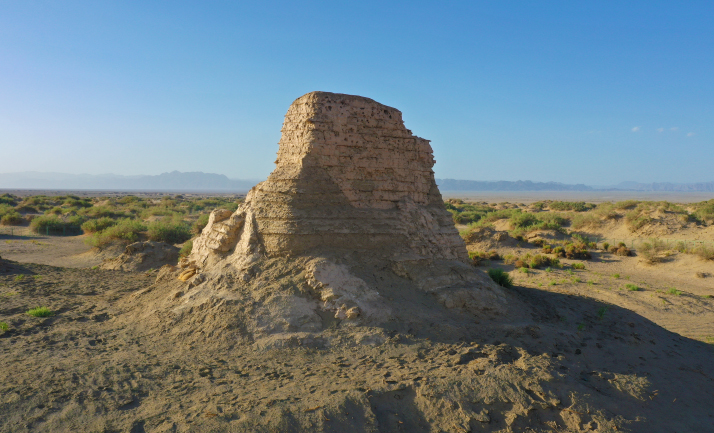 The Keyakekuduke Watchtower Site in Yuli on June 5, 2022 (VCG)
In the desert area 90 km southeast of Yuli County in Bayingol (Bayingolin) Mongolian Autonomous Prefecture lies the Keyakekuduke Watchtower Site, a national key cultural relic protection unit along the Peacock River. It was originally built under the military administration of the Yanqi Garrison in the Tang Dynasty (618-907) and served as both a watchtower and military administrative outpost. The Xinjiang Institute of Cultural Relics and Archaeology conducted archaeological excavations at the site from 2019 to 2021. The excavations covered a total area of 2,300 square meters, revealing 12 features, including dwellings, a wooden fence and ponds, as well as more than 1,450 artifacts or sets of artifacts associated with the work and daily life of frontier soldiers. Among these, 883 documents are particularly noteworthy. They include paper documents, wooden slips, silk manuscripts and engravings. It is the largest and most systematically organized collection of frontier documents of the Tang Dynasty discovered to date. These firsthand archaeological findings and textual materials help reconstruct the everyday life of ordinary frontier soldiers stationed in the desert who combined military duties with agricultural work. Their perseverance reflects the effective administration of the Western Regions—or xiyu in Chinese, which includes today's Xinjiang—by the Central Government in the Tang Dynasty. A patrol post Evidence indicates that the Keyakekuduke was operational between 692 and 790. Unearthed documents show that in addition to its warning function, it also housed a patrol post, subordinate to Yanqi, one of the four garrisons of the Grand Anxi Frontier Command. The command was responsible for managing several beacon stations along the Loulan route, a significant section of the ancient Silk Road. The Grand Anxi Frontier Command was first located in Jiaohe, which is near present-day Tulufan (Turpan). Later it moved to Qiuci in today's Aksu Prefecture. The historical sites of ancient Qiuci are spread across what are now Kuche (also spelt Kucha or Kuqa) and Aksu cities as well as Baicheng, Xinhe and Shaya counties in Aksu. The patrol post was a grassroots mobile military institution in the frontier defense system, managing the daily operation of the beacon system and undertaking patrols and intelligence collection along the route. One of the documents unearthed was a report from a beacon station to its superior patrol post about inspection conditions—by examining tracks on the ground, soldiers found only cattle hoofprints within their jurisdiction, with no traces of human or horses, and immediately reported the situation as safe. The Tang Dynasty had complete and strict regulations for beacon frontier defense. Each watchtower had one commander, one deputy and several soldiers, and they worked in shifts. This rigorous defense system has been verified by the archaeological remains at the site. Military documents form the main part of the unearthed documents. Military orders from superiors, inspection records submitted by grassroots units, personnel transfer and promotion files, applications concerning the disposal of weapons and supplies, military grain income and expenditure accounts, and even treatment of sick warhorses—all matters, great and small, were documented. 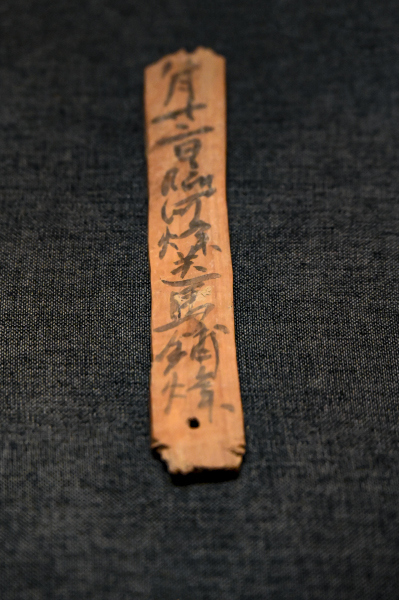 A wooden slip unearthed from the Keyakekuduke Watchtower Site in Yuli on display at the Xinjiang Uygur Autonomous Region Museum on February 22 (VCG)
Garrison life The Western Regions were vast, with long and arduous routes, making material transport from the Central Plains, the heartland of ancient China that covered the middle and lower reaches of the Yellow River, prohibitively costly and difficult to sustain. Garrison farming, which combined military service with agricultural production, was a common means of survival for frontier soldiers in the Tang Dynasty, and related evidence has been found at the Keyakekuduke site. This model significantly alleviated the military supply problem within the vast frontier, and allowed Central Plains agricultural techniques and crops to take root in the Western Regions, becoming an important vehicle for economic and cultural exchange. Archaeologists uncovered large quantities of crop remains and fruit pits including wheat, highland barley, millet, broomcorn millet, jujube pits, peach pits and apricot pits from around the watchtower and in ash pits, along with fragments of a range of farming tools including iron sickles, broken iron plows, stone hoes and threshing stones. The Gobi desert soil was saline, water was scarce and sandstorms were frequent, making farming difficult. After completing their military duties, soldiers all devoted themselves to garrison farming—clearing land, channeling water, planting in spring and harvesting in autumn, using human effort to combat the barren desert. Hundreds of military grain ledgers and income-expenditure accounting documents unearthed at the site recorded the details of farming and material management. The documents registered in detail seed distribution, cultivated acreage, grain harvests, loss write-offs and soldier ration allocation, with neat handwriting and clear accounts. According to documents, the beacon stations implemented a ration system, with soldiers' daily rations strictly fixed and no excess withdrawal allowed without special circumstances. Part of the harvested grain was consumed by the garrison soldiers, part was submitted to superior military garrisons, and the remainder was stored for emergencies. The harsh natural environment made grain harvests highly unstable, and documents repeatedly recorded "sandstorms damaging seedlings, droughts and floods causing poor harvests." Soldiers would also gather wild vegetables from the Gobi and hunt small birds and animals to supplement their diet. The pottery jars, pots, wooden bowls and spoons unearthed were worn, broken and had been repeatedly repaired, reflecting the harsh living conditions. Large quantities of hemp cloth, wool fabric fragments, and leather boots and belts were unearthed. Some clothing had been mended multiple times. Their stitching was fine, but the signs of wear were unmistakable—confirming the reality of long supply cycles and difficult replacement of frontier materials. The dwellings were cramped. Soldiers used reeds and red willow branches woven into mats, laid on the ground to insulate against the cold dampness. Several wooden slips record soldiers' requests to repair roofs and replace doors and windows. These trivial life details bring to life the figures who once huddled in the wind and sand a thousand years ago. Despite the hardships, occasional records of "borrowing wine" and "buying medicine" in the documents, along with a bone hairpin carved with patterns, reveal soldiers' subtle pursuit of comfort and beauty in harsh military life. This resilience in the face of extreme hardship is precisely the human foundation upon which the frontier was stabilized during the Tang Dynasty. 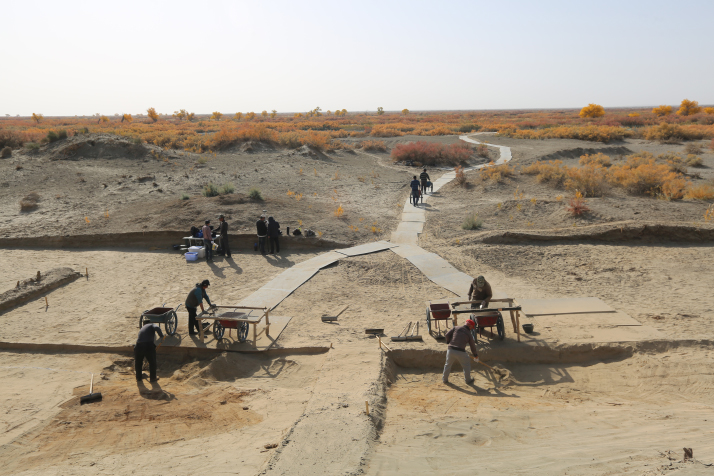 Archaeological excavation at the Keyakekuduke Watchtower Site in Yuli County, Bayingol (Bayingolin) Mongolian Autonomous Prefecture, on April 3, 2015 (VCG)
Letters home The most moving documents are the scattered private letters and literary manuscripts, containing all the human warmth and spiritual sustenance of the frontier soldiers. Unearthed at the site were copies of Confucian primers such as the Classic of Filial Piety and the Thousand Character Classic, as well as popular literary works from the Central Plains. The finds show that soldiers, beyond their guard duties and farming, persisted in reading, writing and studying classics. These Central Plains cultural texts took root in the desert with the soldiers, allowing the literary tradition to continue in the barren frontier, becoming spiritual solace in their often dull lives and promoting the spread of Central Plains culture in the Western Regions. Among the paper documents, private letters and literary works account for a considerable portion. One family letter begins: "As spring gradually fills the air with fragrance and the weather grows warmer, I wonder how..." Another fragment is even more moving: "My wife, don't be sad. Take care of the wheat and sheep, and don't leave them unattended..." A small number of incomplete family letters are even more poignant. Most frontier soldiers were commoners from the Central Plains, sent to guard the frontier thousands of kilometers away in the Western Regions, often unable to return home for years. Documents preserve fragments such as "stationed far from home for years, longing to see my family" and "sick with cold, no one to care for me." The Western Regions lacked doctors and medicine, and the climate was harsh; documents repeatedly record soldiers suffering from cold, rheumatism and injuries, for which only basic herbal remedies were available. Many soldiers stood guard while ill and died at the frontier. The vast desert's solitude and the companionship of wind and sand were the most common emotional influences on the frontier soldiers. In years without the smoke of battle, they climbed high to watch day after day, plowed in spring and harvested in autumn year after year, silently persevering under strict institutional constraints, harsh living conditions and enduring homesickness. These soldiers, many of whom are unnamed, without achievements recorded in history, shouldered the responsibility of defending the frontier and guarded the peace of the vast Western Regions. The site was selected as one of China's Top 10 Archaeological Discoveries of 2021. A thousand years of wind and sand have swept by but the watchtower's ruined walls remain. Every artifact and every piece of paper bearing traces of ink unearthed contributes to our understanding of Tang Dynasty frontier history. Comments to lanxinzhen@cicgamericas.com |
|
||||||||||||||||||||||||||||
|